
Salesforce Managed Services: The Ongoing Support Model That Keeps Your Org Healthy (and Your Team Sane)
Salesforce is not a “set it and forget it” platform. It’s a living system. You have three major releases a year, constant feature updates (including AI), and an endless stream of user requests, reporting needs, and process changes.
That’s why Salesforce managed services exist. Not as a break/fix hotline, but as a proactive support model that keeps your org optimized, secure, release-ready, and aligned with the way your business runs.
In a rush? Take this downloadable guide with you instead.

Table of Contents
SECTION 1 What Are Salesforce Managed Services?
- Proactive optimization
- Structured planning and delivery
- Release readiness and testing
- Continuous improvements tied to business goals
SECTION 2 Why Choose Salesforce Managed Services (Rather Than Reactive Support)
Most orgs don’t collapse when Salesforce isn’t actively managed. They just get harder to run.
Dashboards slowly stop matching reality. Automations become risky to touch. Data cleanup becomes a recurring ritual. Users lose confidence and start building parallel systems in spreadsheets or inboxes just to get through the week.
Salesforce managed services reverses that trend by replacing reactive fixes with an operating rhythm. You plan work intentionally, prioritize based on impact, test changes safely, and reduce the “surprises” that make Salesforce feel unpredictable.
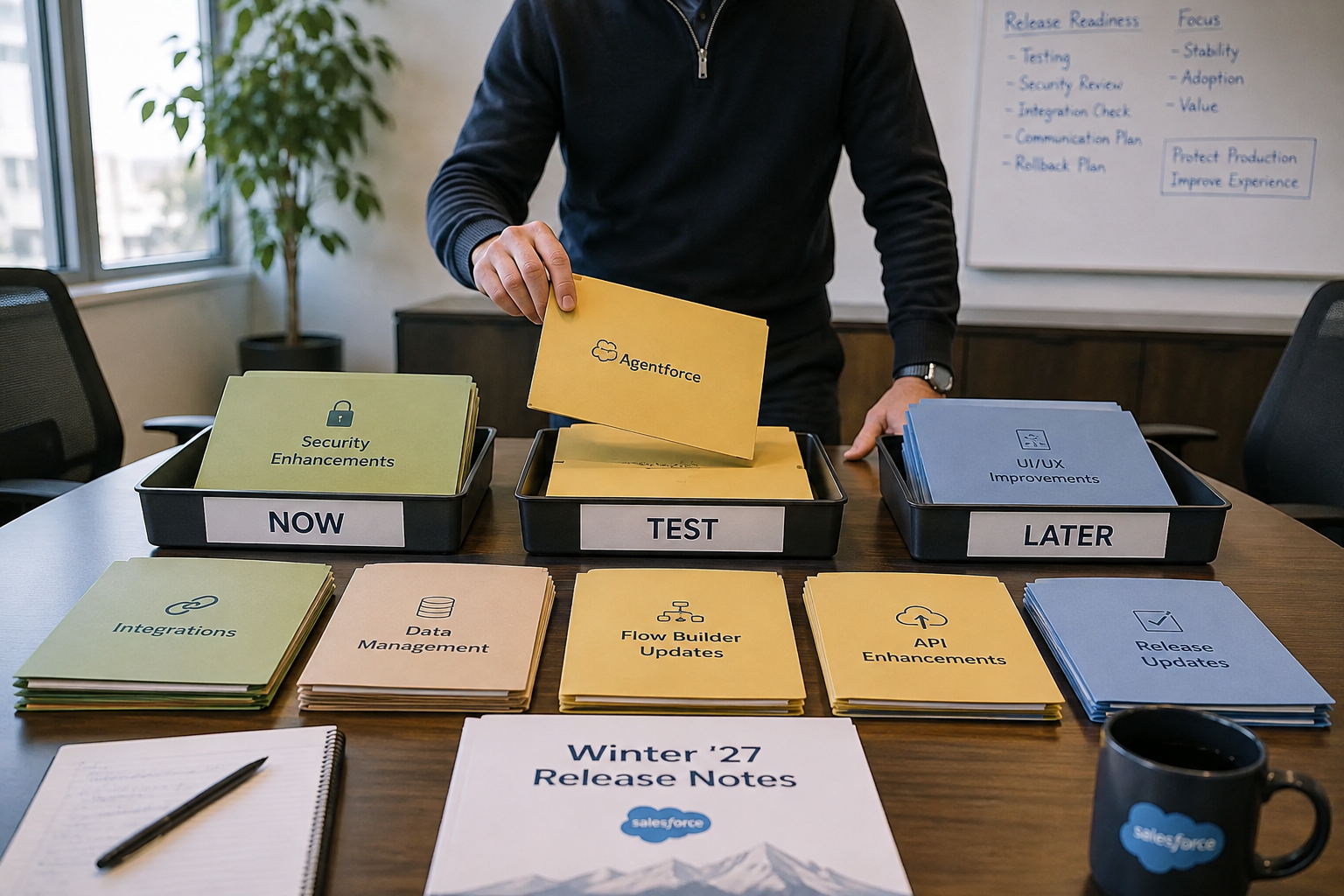
This is also where release readiness makes a real difference. Salesforce publishes release resources and release notes, but someone still needs to translate them into “what does this mean for our org?” and “what should we test?”
Helpful Salesforce resources:
SECTION 3 When Salesforce Managed Services Are the Best Fit for Your Team
Salesforce managed services are typically a strong fit when your Salesforce needs outgrow the “we’ll handle it internally” stage. What used to be manageable starts taking longer, feeling riskier, and pulling time away from higher-value work. If any of the signs below feel familiar, it may be time to bring in ongoing support.
Persistent Backlog
Requests pile up, priorities get stuck, and Salesforce work becomes a constant queue.
Uneven Adoption
Some teams use Salesforce consistently while others avoid it—so data quality and follow-through slip.
Unreliable Reporting
Different teams trust different numbers, and reporting becomes a debate instead of a decision tool.
It’s also a common fit when teams want to adopt AI features like Agentforce Assistance (Einstein Copilot) or strengthen automation, but they know their data and governance need cleanup first. AI does not create value by itself. It performs best when the underlying data, processes, and security model are well structured.
Still Wondering if Salesforce Managed Services Are Right For Your Setup?
Talk to Dynamic Specialties Group to see if managed services are the right fit.
SECTION 4 What’s Usually Included in Salesforce Managed Services (and What’s Usually Not)
Most Salesforce managed services partnerships are built around the steady, ongoing work that keeps your org reliable and getting better over time.
With DSG, what’s included is the day-to-day and month-to-month support that helps Salesforce stay clean, current, and usable. It covers the practical improvements teams feel immediately, like keeping automations healthy, tightening reporting so numbers match reality, improving data quality, staying on top of releases, and handling the configuration and updates that always seem to pile up. It also includes structured deployment practices, so changes are tested and moved through environments in a controlled way instead of pushed live with crossed fingers.
To keep your monthly plan focused and predictable, larger initiatives are typically scoped separately. That usually includes big net-new builds or major expansions, complex integrations, large data migrations, major implementation work, or anything that requires a dedicated project timeline and deeper discovery.
The goal of Salesforce managed services isn’t to kick those requests down the road. It’s to make sure the monthly cadence stays centered on continuous improvement, while bigger efforts get the proper planning, resourcing, and scope they deserve.
Let’s breakdown full managed services vs. hiring in-house.
SECTION 5 Salesforce Managed Services vs. Hiring In-House
At some point, most teams ask the same question: should we hire an admin/developer, or partner with a Salesforce managed services team?
Hiring in-house can be a great move when you have a steady, day-to-day stream of Salesforce work and you want long-term ownership sitting inside the business. For a lot of organizations, though, the workload comes in waves. You get a burst of requests, a release hits, priorities shift, and suddenly you either have too much work for one person or not enough work to justify a full team.
That’s where Salesforce managed services is a practical middle ground. You get coverage and expertise without taking on the full overhead of hiring, onboarding, and hoping one person can cover every skill set your org needs.
|
Challenge |
Full-Time Hire |
DSG Managed Services |
|
Annual Cost |
~$100K+ with benefits |
Predictable monthly plan |
|
Skillset |
One person’s expertise |
Certified team: admin + dev + BA |
|
Availability |
40 hrs/week |
Scales to your needs |
|
Release Monitoring |
Manual |
Proactive + automated |
|
Continuity |
Subject to turnover |
Always-on coverage |
The quick way to read this section is simple: a full-time hire gives you one person’s strengths, one person’s availability, and one person’s bandwidth. Salesforce managed services gives you a team model that can scale up and down based on your needs, plus built-in continuity when vacations, turnover, or competing priorities show up.
If you already have an internal admin, this isn’t an either/or decision. Many teams use a hybrid approach: keep internal ownership close to the business, and use managed services for release readiness, backlog surges, DevOps discipline, and specialized support that’s tough to cover with a single role.
SECTION 6 How Getting Started with Managed Services Onboarding Works (Without Turning Into a Big Project)
If “managed services onboarding” sounds like a six-week marathon, take a breath. The goal at the start is simple: get clarity fast, reduce risk, and deliver a first round of improvements that your team actually feels.
We typically begin with a kickoff to confirm goals, access needs, and the big pain points. Then we run a focused org health check to identify what’s stable, what’s fragile, and what could become a problem during the next release. From there, we triage your backlog so you’re not treating every request like it’s a fire, and we agree on what “success” looks like for the first sprint.
By the end of the first cycle, you should have two things: a cleaner, safer org, and a plan that’s understandable by humans. Not just admins.
Ready to Onboard Salesforce with Confidence?
If you are onboarding Salesforce for the first time or re-onboarding after a messy start, we can help you simplify the process.
We focus on the essentials that drive adoption and keep your CRM clean, including data structure, security, reporting, and the workflows your team needs most.
Reach out and we will map the best next steps for your business.
SECTION 7 What Success Looks Like After Implementing Salesforce Managed Services
The biggest change most teams notice is not a single dramatic improvement. It’s that Salesforce feels lighter.
The backlog starts shrinking instead of growing. Users stop working around the system. Reporting becomes more reliable. Automations become something you can improve instead of something you fear. Releases stop being stressful events and become manageable check-ins.
That’s the real goal: steady improvement that compounds.
SECTION 8 How to Choose the Right Salesforce Managed Services Partner
A Salesforce managed services partner should be able to clearly explain who will support you, how they deploy safely, how they handle releases, how they prioritize work, and how they report progress. They should be proactive, transparent, and comfortable tying Salesforce work to business outcomes, not just technical tasks.
A good partner also helps you avoid the two extremes: overbuilding (customizing everything because you can) and underbuilding (avoiding needed improvements because change feels risky). The right team brings both platform expertise and real-world judgment.
If the partner can’t describe their process in plain language, or can’t show how they measure success, that’s a signal to keep looking.
FAQs About Salesforce Managed Services
Below are answers to common questions about what managed services include, how they work, and when they make sense.
How many hours of Salesforce managed services do we need?
Most teams start with a tier that covers a steady cadence of improvements without overwhelming internal stakeholders. The right level depends on backlog size, release impact, and how much change your business expects over the next quarter. A quick health check and backlog review usually makes the right tier obvious.
Is Salesforce managed services only for large companies?
Not at all. It’s often most valuable for small and mid-sized teams that rely heavily on Salesforce but don’t want to hire a full internal team. Managed services helps you scale expertise without scaling headcount.
What’s the difference between managed services and “support”?
Support is often reactive. Managed services is proactive. The goal is stability, release readiness, and continuous improvement, not just closing tickets.
Can we still do big projects?
Yes. Many teams handle major initiatives as separate projects, then use managed services to maintain, optimize, and evolve what was built. It’s a clean way to keep the monthly cadence stable while giving bigger work the scope it deserves.
SECTION 9 What a Salesforce Managed Services Partnership Looks Like at DSG
A healthy Salesforce managed services partnership should feel clear and predictable. The work should not be a mystery, and progress should not rely on emergencies to get attention.
Dynamic Specialties Group typically starts with discovery and an org health check to understand what is working, what is risky, and where the quickest wins are. From there, we help organize and prioritize your backlog based on business value. Each quarter, we align improvements to upcoming initiatives and platform updates. Each month, we deliver work in a sprint cadence with testing and deployment practices that reduce surprises.
Communication is built into the model. You should always know what was completed, what is next, and how the plan is tracking against goals.
Ready to Make Salesforce Easier to Run?
If Salesforce is critical to your business, it deserves a support model that keeps up with change. DSG’s Salesforce managed services helps teams reduce risk, improve adoption, and build a CRM that stays reliable as the business evolves.
If you’re ready to replace firefighting with a steady cadence, let’s talk about what ongoing support could look like for your org.
Contact Dynamic Specialties GroupTalk to a Salesforce Managed Services Expert
Tell us a little about your Salesforce org and what you want to improve. We’ll follow up to schedule a quick call and recommend next steps.


SHARE