

If your dashboards don’t agree, your revenue engine isn’t aligned. Let’s start with a scene that might feel uncomfortably familiar.
Sales is celebrating a record quarter. Marketing is thrilled about campaign engagement. Customer Success is quietly worried about churn. Finance is building a forecast that somehow doesn’t match anyone else’s numbers. Meanwhile, your CEO is staring at three reports that all claim to show “revenue truth”—and none of them agree.
Welcome to the wild world of “we have a CRM, but we don’t really have alignment.” That’s usually the moment someone asks, “Do we need RevOps?”
And shortly after that, someone else asks, “Wait… what is a CRM consultant, and can they fix this?”
Let’s talk about it. Because when done right, CRM consulting services—particularly strategic Salesforce CRM consulting—don’t just implement software. They engineer the operational foundation that makes a real RevOps strategy work.

A RevOps Strategy Sounds Simple. Until It Isn’t.
At its core, Revenue Operations is straightforward. Align Sales, Marketing, and Customer Success around one shared revenue engine. One funnel. One lifecycle. One source of truth.
In theory, that sounds obvious. In practice, it’s where things start to drift.
Buying Salesforce doesn’t create alignment. Hiring a RevOps manager doesn’t automatically resolve structural gaps. Building more dashboards doesn’t generate clarity.
Salesforce itself is extraordinarily capable. It can enforce required fields, validation rules, stage progression logic, structured sales paths, automated handoffs, and sophisticated forecasting models.
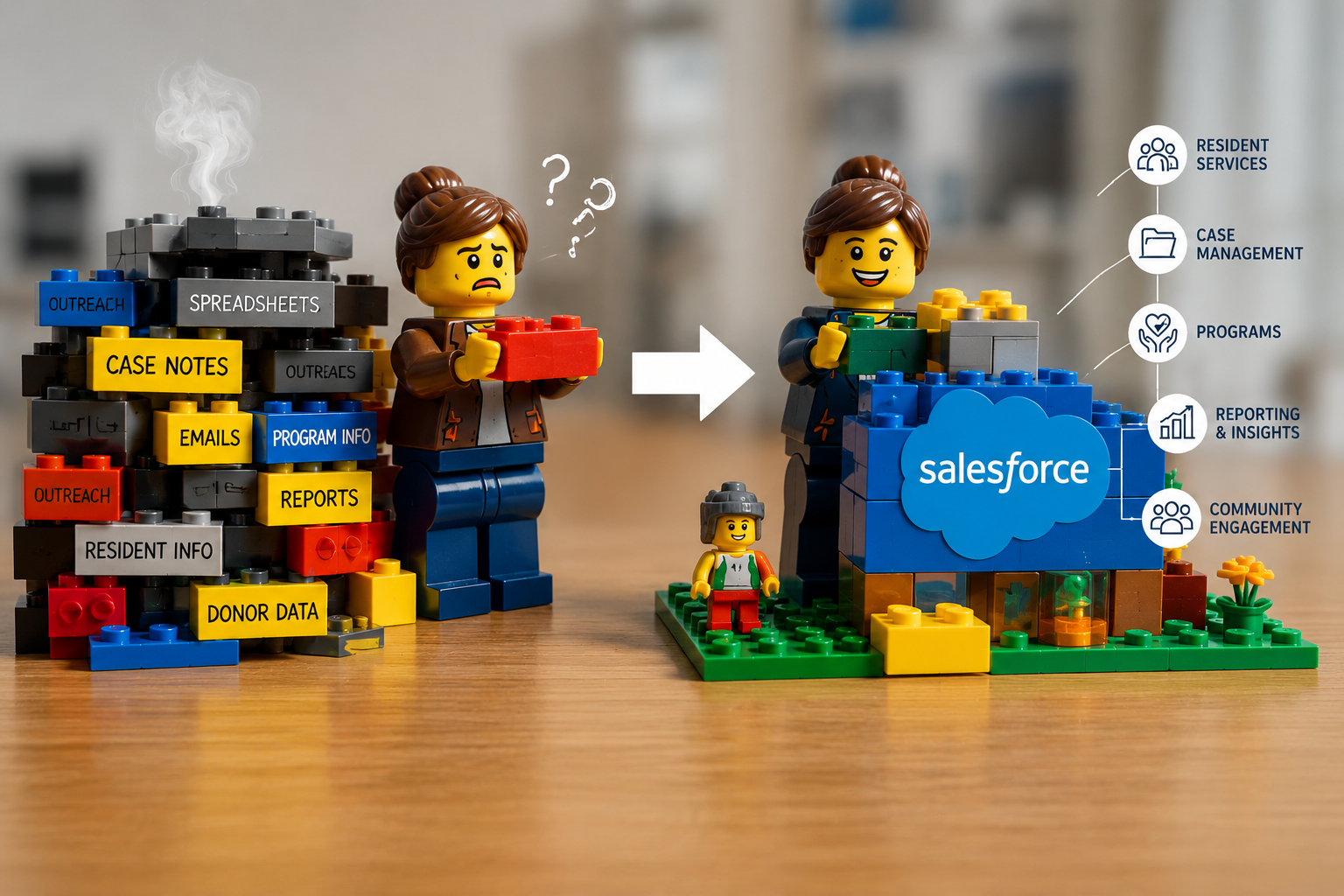
But capability is not the same as coherence. Without deliberate system design, even the most powerful CRM becomes a well-documented mess. That’s where experienced CRM consultants step in.
What Is a CRM Consultant, Really?
If you’ve ever searched “what is a CRM consultant,” you’ve likely seen definitions centered around implementation, integrations, and configuration.
That’s accurate—but incomplete.
A CRM consultant is a strategist who happens to work inside technology. They translate revenue goals into system logic. They examine how leads become opportunities, how opportunities become customers, and how customers become renewals and expansion revenue.
More importantly, they ask the uncomfortable questions. Why does Marketing’s definition of a qualified lead differ from Sales’ expectations? Why are renewals tracked outside Salesforce? Why does Finance hesitate to rely on CRM forecasts? Why does every department use slightly different lifecycle terminology?
Professional CRM consulting services don’t just configure fields. They reconcile definitions. They standardize motion. They embed alignment into the system itself. When Salesforce is the platform, the opportunity for clarity is enormous. So is the risk of accidental complexity.
When Do You Know You Need CRM Consulting Services?
The warning signs are rarely dramatic. They’re subtle. Sales exports pipeline data into spreadsheets before forecast calls “just to double-check.” Marketing isn’t fully confident about which leads actually convert. Customer Success maintains separate renewal trackers to avoid surprises. The RevOps hire feels like a referee more than a strategist.
Individually, these workarounds might seem harmless.
Collectively, they signal something important: your CRM reflects history, not intentional design.
That’s usually the inflection point when strategic Salesforce consultants shift from optional support to essential partners.
Where RevOps Strategy Quietly Breaks
RevOps doesn’t collapse overnight. It erodes gradually.

Each decision makes sense in isolation. But without a shared revenue model embedded inside Salesforce, those local optimizations fragment the broader system.
Conversion rates appear inflated. Forecast accuracy fluctuates. Leadership meetings turn into data reconciliation sessions. That isn’t a people issue. It’s a systems design issue.
Aligning RevOps Strategy with a CRM Consultant
Cross-functional meetings are helpful. Shared Slack channels are helpful. Leadership alignment is helpful. But if you configure Salesforce to allow inconsistent stage movement, loosely defined lifecycle transitions, or unmanaged customization, misalignment will persist—even though the platform is fully capable of enforcing discipline when intentionally designed.
A strong RevOps strategy requires infrastructure that reinforces behavior, and that’s where thoughtful Salesforce CRM consulting creates measurable impact.
Rather than layering automation onto unclear processes, experienced CRM consultants step back and map the full revenue journey. They clarify ownership at each stage. They define advancement criteria. They align lifecycle transitions. They configure validation rules and required fields to protect data integrity. They design forecasting structures that reflect how deals actually progress.
When the system supports the strategy, alignment becomes structural—not aspirational.
4 Common Mistakes with RevOps Strategy
Most organizations don’t intentionally build fragmented revenue engines. Drift happens quietly.
1. Over-customization is one common culprit. A custom object solves a short-term need.
2. Automation addresses a special case. Another field is added “just in case.” Over time, Salesforce accumulates layers of legacy logic that few people fully understand.
3. Automation can also magnify confusion. If stage definitions are unclear, automating them only accelerates inconsistency rather than solving it.
4. And then there’s decentralized lifecycle logic. Marketing optimizes for engagement. Sales optimizes for velocity. Customer Success optimizes for retention. Without a unified operational model inside Salesforce, the CRM becomes a set of adjacent workflows rather than one cohesive revenue engine.
Strategic CRM consulting services prevent this by emphasizing configuration-first design, disciplined governance, and customization only when it supports measurable business outcomes.
Evolving Your RevOps Strategy (Over Time)
One of the biggest misconceptions about RevOps is that it’s a one-time initiative. It isn’t.
A startup focused on new logo acquisition has a relatively simple revenue model. A scaling organization managing renewals, cross-sells, channel partnerships, and multi-product offerings faces increasing complexity. An enterprise operating across regions introduces additional layers of governance, forecasting nuance, and reporting requirements.
Your Salesforce environment must evolve alongside that growth.
This is why ongoing Salesforce CRM consulting often delivers long-term value beyond initial implementation. As revenue streams diversify and team structures mature, the CRM requires periodic refinement to prevent technical debt and maintain operational clarity.
Sometimes that means advisory guidance. Sometimes it’s a new installation aligned to a more mature revenue model. Sometimes it’s a structured org revitalization. And sometimes it’s ongoing monthly support to ensure the system keeps pace with change. A durable RevOps strategy grows with the business. Your CRM should, too.

The Measurable ROI of CRM Consultants in RevOps
When system architecture aligns with revenue strategy, tangible improvements follow.
Forecasts become more reliable because opportunity stage definitions—and the forecast categories Salesforce derives from them, unless intentionally overridden—reflect real buyer behavior and realistic deal progression.
Pipeline visibility improves because lifecycle transitions are standardized. Renewals become more predictable because Customer Success data lives inside the same ecosystem as Sales activity. Revenue expansion becomes proactive rather than reactive.
Most importantly, executive conversations change. Instead of debating whose numbers are accurate, leadership teams focus on forward-looking strategy. They spend less time reconciling data and more time making decisions. That shift alone often justifies the investment in strategic CRM consulting services.
CRM Consultants: Final Thoughts
When companies invest in experienced CRM consultants, they aren’t just improving software. They’re clarifying ownership, defining accountability, standardizing definitions, and embedding governance into the revenue engine itself. That’s what transforms a CRM from a reporting tool into infrastructure.
If your dashboards spark debate instead of confidence, if forecasting feels more hopeful than predictable, or if alignment exists in meetings but not in data, the issue likely isn’t effort. Its structure. And that’s precisely where strategic Salesforce CRM consulting proves its value.
Because engineered growth scales. Accidental growth stalls.





SHARE