
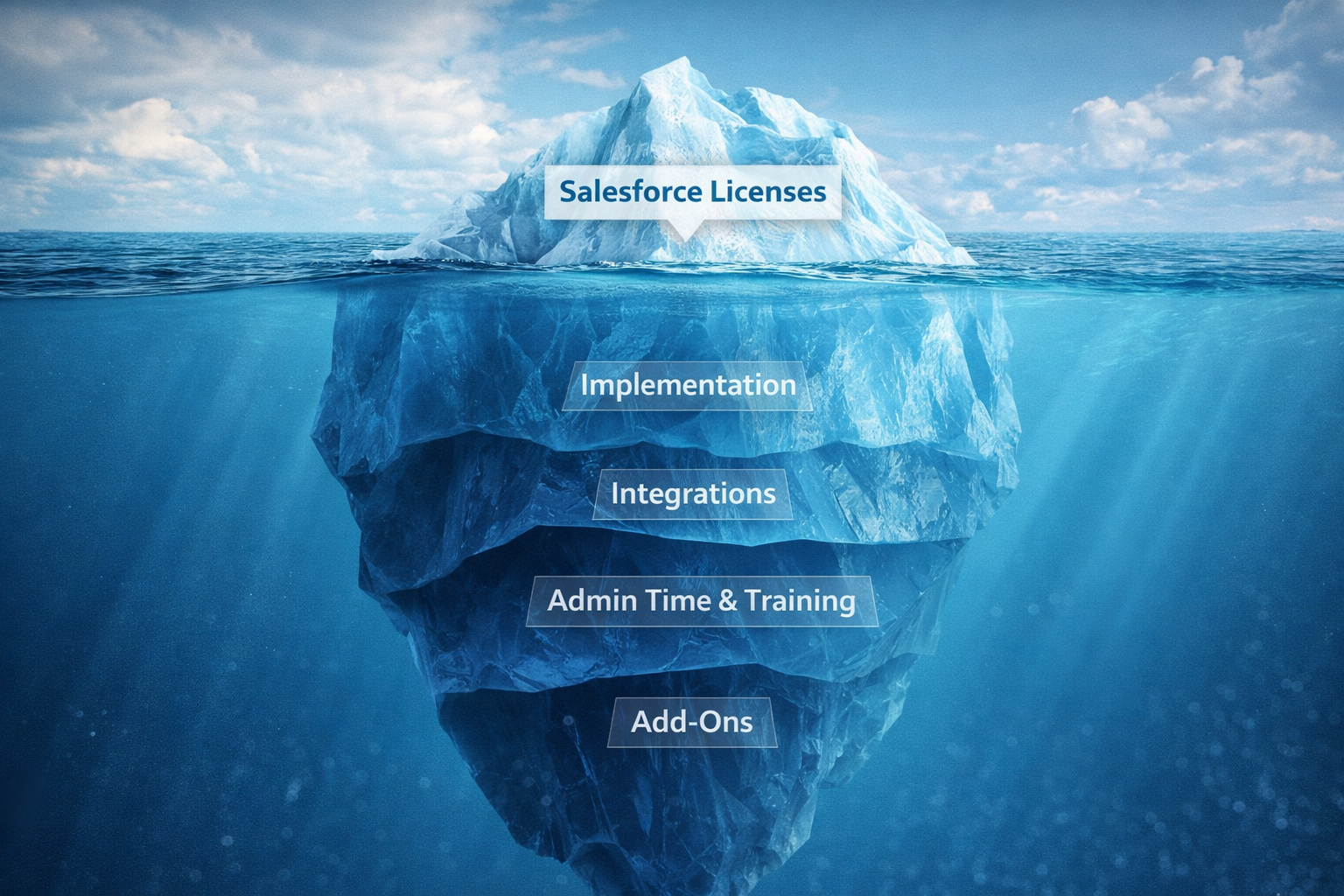
There’s a particular moment that happens in small businesses and nonprofits everywhere.
Someone says, “We should probably get Salesforce.”
Everyone nods. Someone searches Google for "How much does Salesforce cost?" And suddenly the room gets quiet.
Because Salesforce pricing doesn’t hand you a single number. Instead, it hands you a maze—license tiers, clouds, nonprofit programs, add-ons, implementation costs, and just enough horror stories to make you wonder if adopting a CRM is a financial rite of passage.
So let’s talk about Salesforce pricing the way people actually experience it. Not the marketing version. Not the Reddit panic version. The real one—what you’ll pay, why you’ll pay it, where costs sneak in, and how to keep CRM pricing from spiraling.
We’ll start with Salesforce pricing for small businesses, then move into Salesforce pricing for nonprofits, and pull back to discuss hidden costs, long-term budgeting, and why the right Salesforce partner can make or break the investment.
 Salesforce Pricing for Small Businesses: What You’ll Actually Pay
If you’re a small business looking at Salesforce, you’re usually evaluating Sales Cloud, Service Cloud, or both. Salesforce license pricing is per user, per month, and this is where CRM pricing starts, not where it finishes.
Salesforce License Pricing for Small Businesses (Starter, Pro Suite, Enterprise, Unlimited)
Before we go any further, it helps to see Salesforce license pricing laid out in one place—no guesswork, no scrolling back and forth—and (disclaimer, so it all makes sense) we’ve included basic pricing for both small businesses and nonprofit organizations in the following table.
Salesforce License Pricing Overview (Small Businesses & Nonprofits)
|
Salesforce Edition |
Typical Use Case |
List Price (Per User / Month) |
Billing Notes |
|
Starter Suite |
Very small teams with basic CRM needs |
$25 |
Monthly or annual billing |
|
Pro Suite |
Growing small businesses need automation & reporting |
$100 |
Typically billed annually |
|
Enterprise Edition |
Advanced customization, reporting, and scalability |
$175 |
Typically billed annually |
|
Unlimited Edition |
Complex or fast-scaling organizations |
$350 |
Typically billed annually |
|
Sales Cloud (Nonprofit – Power of Us) |
Eligible nonprofits |
10 donated Enterprise licenses |
Additional licenses discounted |
|
Nonprofit Cloud – Enterprise |
Program, donor, and impact management |
$60 |
Billed annually |
|
Nonprofit Cloud – Unlimited |
Advanced nonprofit use cases |
$100 |
Billed annually |
*Salesforce pricing shown reflects list pricing and published nonprofit programs. Actual costs may vary based on contracts, bundles, and implementation approach.
Salesforce’s entry point is Starter Suite, priced at $25 per user per month. The Starter Suite is available monthly or annually and is designed for very small teams with basic CRM needs.
Next is Pro Suite, which runs $100 per user per month. Many people still think of this as “Professional Edition,” and it’s where Salesforce starts to feel genuinely powerful for growing businesses.
From there, Enterprise Edition comes in at $175 per user per month. This is where advanced automation, customization, reporting, and scalability really live, and where many small businesses eventually land.
At the top end is the Unlimited Edition, priced at $350 per user per month and typically reserved for complex or fast-scaling organizations with significant support and customization needs.
With the exception of Starter, Salesforce subscriptions are typically billed annually.
So if you have ten users on Pro Suite, you’re looking at roughly $12,000 per year in licenses. Twenty users on Enterprise? About $42,000 annually. That’s your baseline Salesforce license pricing—before implementation, integrations, or customization.
How Much Does It Cost to Implement Salesforce for a Small Business?
To ground this in reality, here’s what Salesforce implementation typically looks like from a cost perspective, based on what we see in the real world.
Estimated Salesforce Implementation Costs
|
Organization Type |
Typical Implementation Scope |
Estimated Cost Range |
|
Small Business |
Core CRM setup, light automation, reporting |
$5,000 – $10,000 |
|
Small Business (Scalable Build) |
Automation, integrations, future-proof design |
$15,000 – $40,000 |
|
Nonprofit |
Donor data, programs, reporting, integrations |
$10,000 – $30,000 |
|
Advanced / Multi-Cloud |
Heavy customization or complex data |
$40,000+ |
Here’s where Salesforce pricing starts to feel murky, mostly because implementation is where Salesforce stops being software and starts being your system.
For small businesses, a bare-bones Salesforce implementation might start around $5,000 to $10,000. That usually means minimal configuration and limited scalability.
A more thoughtful, scalable implementation—one that accounts for reporting needs, automation, integrations, and future growth, and balances configuration and customization—typically falls between $15,000 to $40,000.
Heavily customized or multi-cloud implementations can exceed that range, especially if data is messy or multiple teams are involved.
The key distinction is this: turning on Salesforce is relatively cheap. Designing it so your business doesn’t outgrow it in six months is where the real investment—and long-term ROI—lives.
Salesforce Pricing for Nonprofits: Discounts, Donated Licenses, and What’s Actually Included
Nonprofits often hear, “Salesforce is free for nonprofits,” and understandably assume the pricing conversation ends there. It doesn’t—but Salesforce pricing for nonprofits is genuinely more accessible.
Through Salesforce’s Power of Us program, eligible nonprofits can receive 10 donated Sales Cloud Enterprise Edition licenses, along with deep discounts on additional licenses. That alone dramatically lowers Salesforce license pricing compared to small businesses.
But licenses are only one part of the overall cost, and nonprofits still need a strategy to avoid unnecessary risks.
How Much Does Salesforce Cost for Nonprofits in the Real World?
In practice, many nonprofits invest between $10,000 and $30,000 for a well-scoped Salesforce implementation. Complexity, data migration, donor reporting, and integrations with fundraising or accounting systems all influence where that falls.
Ongoing costs tend to be lower than in the for-profit world. However, add-ons like donor management tools, marketing integrations, or analytics platforms can still add several thousand dollars per year.
Nonprofits also tend to need more customization than expected. Donor journeys, grants, programs, and compliance reporting don’t always map neatly to out-of-the-box CRM models—which is why design matters so much here.
Salesforce Nonprofit Cloud Pricing vs. Donated Sales Cloud Licenses
It’s also important to note that Salesforce now publishes Nonprofit Cloud pricing separately from donated Sales Cloud licenses.
Nonprofit Cloud pricing currently starts at $60 per user per month for Enterprise and $100 per user per month for Unlimited, billed annually. These offerings are distinct from the Power of Us donated licenses and are often used alongside—or instead of—traditional Sales Cloud, depending on the nonprofit’s needs.
This distinction matters, and choosing the wrong model can lead to unnecessary costs.
The Hidden Costs of Salesforce CRM Pricing (What Most Companies Miss)
Hidden costs are where Salesforce pricing quietly goes off the rails—not because Salesforce is overpriced, but because the hidden costs add up.
There’s the internal time required to manage the system. There’s technical debt from rushed customizations. There’s the cost of unused licenses because no one revisited roles. There’s rework because data didn’t migrate cleanly the first time.
Then there are third-party tools.
Marketing automation platforms, CPQ tools, data enrichment services, and integration platforms often cost $30 to $150 per user per month, or several thousand dollars annually per tool. Individually, they seem reasonable. Stack them without a strategy, and CRM pricing quietly doubles.
These costs are avoidable only if Salesforce is designed intentionally from the start.
Why Salesforce Pricing Looks Different After Year One
Here’s the part most pricing blogs skip. When Salesforce gets implemented well, costs usually stabilize after year one. Licenses align with actual usage. Customization slows. Enhancements become intentional instead of reactive. Salesforce stops feeling like a project and starts behaving like infrastructure.
When Salesforce gets implemented poorly, year two is when frustration sets in—reporting gaps surface, users resist adoption, technical debt compounds, and organizations end up spending more fixing decisions than on building momentum.
The difference isn’t the platform; it’s the plan.
How to Budget for Salesforce Without Guessing (Licenses, Implementation, Ongoing Costs)
The most successful organizations don’t try to predict an exact number down to the dollar. They budget in ranges and intentionally phase investments.
Salesforce license pricing is predictable. Implementation is a one-time lift that should be scoped carefully. Ongoing optimization should be targeted and purposeful—not open-ended.
This approach allows organizations to grow into Salesforce instead of paying for everything upfront “just in case,” and it turns CRM pricing into a strategic decision rather than a recurring stressor.
Is Salesforce the Right CRM for Your Business or Nonprofit?
This question matters more than people expect. Salesforce isn’t always the right CRM for very small teams with straightforward needs. If your organization has minimal process complexity and limited reporting requirements, Salesforce can feel like overkill.
Where Salesforce shines is in scale, complexity, compliance, and growth: multiple stakeholders, long sales cycles, program tracking, regulatory reporting, and cross-team visibility. A good Salesforce partner will tell you that upfront, even if it means advising against Salesforce entirely.

Why Salesforce CRM Pricing Feels Different From Other CRMs
Most CRMs are tools. Salesforce is a platform. That’s why CRM pricing comparisons often feel unfair. Salesforce isn’t just selling features. Instead, it’s selling flexibility, extensibility, and an ecosystem that can evolve with your organization.
That power is what makes Salesforce worth the investment when used well, and overwhelming when approached casually.
So, How Much Does Salesforce Cost Overall?
For small businesses, Salesforce pricing typically ranges from $15,000 to $60,000 in year one, depending on user count, complexity, and growth goals.
For nonprofits, Salesforce can often be implemented effectively for between $10,000 to $40,000, with significantly lower ongoing license costs thanks to donated licenses and nonprofit pricing programs.
Anything far below those ranges usually means somebody cut corners. Anything far above them usually means somebody skipped the planning/discovery phase.
Salesforce Pricing FAQs (Quick, Honest Answers)
People usually ask these questions right before—or right after—Googling Salesforce pricing for the fifth time.
How much does Salesforce cost per user?
Salesforce license pricing ranges from $25 to $350 per user per month, depending on edition, features, and contract type.
How much does it cost to implement Salesforce?
Most small businesses and nonprofits spend $10,000 to $40,000 on implementation, depending on complexity, integrations, and customization.
Why does Salesforce pricing vary so much?
Because Salesforce is a platform, not a one-size-fits-all tool, the flexibility that makes it powerful also makes pricing dependent on how intentionally it’s designed.
Final Thoughts on Salesforce Pricing for Small Businesses and Nonprofits
Salesforce doesn’t blow budgets. Unclear goals, rushed decisions, and a lack of guidance do.
If you’re asking how much Salesforce costs or how much it costs to implement Salesforce, the smartest next step isn’t buying licenses; it’s clarifying what you actually need.
That’s where Dynamic Specialties Group comes in. We help small businesses and nonprofits design Salesforce intentionally, avoid unnecessary spend, and build CRM solutions that scale without spiraling costs.
And sometimes, we’ll tell you Salesforce isn’t the right answer at all. That honesty alone has saved organizations more money than any discount ever could.
If you want clarity instead of guesswork, you’re already asking the right questions.



SHARE