

Let’s start with a confession.
Most companies don’t wake up one morning and say, “Today feels like a great day to become an Agentic Enterprise.” They wake up saying things like:
“Why does this deal stall every single time?” “How do we have five dashboards and none of them agree?” “Did our AI just recommend that?”
If that sounds familiar, congratulations! You’re exactly where the journey starts.
An Agentic Enterprise isn’t about slapping AI onto Salesforce and hoping for magic. It’s about designing a system where intelligent agents can act, decide, and optimize—within clearly defined logic, permissions, and goals you’ve explicitly designed—and always in alignment with how your business actually works.
We think of it less like “installing AI” and more like raising a capable, well-trained digital workforce inside Salesforce.
So let’s talk about how to do that—step by step—without breaking your org, your budget, or your sanity.
What Is an Agentic Enterprise on Salesforce?
Before we go any further, let’s clear something up. An Agentic Enterprise is not just better automation. And it’s definitely not a chatbot with confidence.
Traditional automation follows instructions. Predictive AI offers suggestions. An agentic system understands context, evaluates options against goals, and takes action based on rules, models, and boundaries you intentionally configure.
In Salesforce terms, that means your platform doesn’t just record what happened. It participates in deciding what happens next. Think less “If X, then Y.” Think more “Given everything we know right now, what’s the smartest next move?” That distinction matters because everything that follows is built around it.
Step 1: Prepare Your Salesforce Org for AI and Agentic Systems
Every Agentic Enterprise story begins with a Salesforce org that thinks it’s ready and usually isn’t.
If your data is inconsistent, your automation overlaps, and your sales process lives half in people’s heads and half in custom fields nobody remembers creating, AI will absolutely notice. And it will respond with unreliable, sometimes hilarious, but mostly dangerous outputs.
Before agents can act intelligently, Salesforce needs to return to being a system of record, rather than a system of creative interpretation—which is precisely why we often recommend starting with a Salesforce org health check before introducing AI-driven systems.
This means cleaning up data models so objects reflect real business concepts, aligning stages and definitions so “Qualified” means the same thing everywhere, and auditing automation so Flows don’t compete like toddlers fighting over the same toy.
This step isn’t glamorous, but it is foundational. Think of it as teaching your future agents the difference between fact, assumption, and guesswork.
Step 2: Design AI-Driven Decisions in Salesforce (Not Just Automation)
If Step 1 was about cleaning the foundation, this is where you decide what good judgment actually looks like.
Traditional Salesforce automation answers the question: “When X happens, what should Salesforce do?” An Agentic Enterprise asks a more interesting question: “Given what we know right now, what should happen next?”
Instead of building one-off automations, you start designing decision frameworks inside Salesforce. What inputs matter most at this moment? What outcomes are you optimizing for: speed, revenue, risk reduction, customer experience? When should a human stay in the loop?
This is where tools like Flow, Einstein Prediction Builder, and Einstein Copilot (aka, Agentforce Assistant) stop being features and become decision engines. And that’s not by inventing logic on their own, but by consistently applying the logic and goals you’ve defined at scale.
We find it helpful to map these decisions as narratives: “When a deal slips, the agent evaluates risk signals, proposes next-best actions, and flags only the deals a human actually needs to review.”
That’s not automation. That’s judgment at scale.
Step 3: Build Trusted Salesforce Data Pipelines for AI
Here’s the thing about agents: they don’t forget, or more accurately, they reason entirely from the data and context you make available to them.
Every bad field definition, every outdated integration, every half-filled record becomes part of their worldview. So before you give agents autonomy, you need data trust.
On Salesforce, this means designing clean ingestion paths, preventing garbage data at the door, and using tools like Salesforce Shield to ensure agents operate within compliance boundaries.
Think of this step as setting household rules before giving your teenager the car keys. Yes, they can drive, but only on approved roads.
Step 4: Use Salesforce AI as a Teammate, Not a Replacement
One of the biggest mistakes we see? Treating AI as if it should immediately replace humans. In an Agentic Enterprise, AI starts as the most prepared intern you’ve ever had. It drafts emails. It summarizes calls. It spots patterns humans miss at scale.
But it doesn’t own final decisions, at least not yet.
On Salesforce, this is where Einstein Copilot, Conversation Insights, and generative summaries create momentum fast. Users trust AI because it helps them today, not because leadership promised it would “transform the business someday,” which is why assessing AI readiness for Salesforce matters before scaling adoption.
Trust compounds. And once users trust the recommendations, you can gradually increase agent autonomy; carefully, intentionally, and with guardrails.

Step 5: Establish Salesforce AI Governance and Guardrails
If Step 2 defined what good decisions look like, this step defines where those decisions are allowed to operate.
Agentic systems don’t need fewer rules. They need better ones.
Guardrails answer questions like what an agent can do automatically, what must be reviewed, and what should never happen without explicit approval. Salesforce enables this through role-based access, approval flows, and AI trust layers that constrain what data models can see and act on.
Freedom comes from structure, and the clearer the boundaries, the more powerful—and safer—your agents become.
Step 6: Common Salesforce Agentic AI Pitfalls (And How to Avoid Them)
This is the part most glossy roadmaps skip. We’ve seen organizations buy AI licenses before fixing data, automate decisions nobody agreed on, and roll out “intelligent agents” that users quietly ignore. And the pattern is always the same: rushing autonomy before earning trust.
Agentic systems don’t fail because the technology isn’t ready. They fail because the organization wasn’t. The fix isn’t slowing down; it’s sequencing correctly.
Step 7: Orchestrate Agentic Workflows Across Salesforce

Salesforce becomes the orchestration layer: the place where role-specific intelligence, Flows, predictions, and recommendations are coordinated, context is cleanly handed off, and escalation happens intelligently.
When done right, humans stop being air traffic controllers and start being strategists.
Step 8: How Agentic Salesforce Changes Sales, Service, and Ops Roles
Once you establish trust in AI, the real change begins. Not in the technology, but in the people.
Agentic Enterprises don’t eliminate roles. They upgrade them.
Sales reps stop chasing updates and start making decisions. Managers coach instead of interrogating dashboards. Ops teams design systems instead of fighting fires.
The work becomes more human—not less—and that’s usually when adoption finally sticks.
Step 9: A Day in the Life of an Agentic Salesforce Organization
Let’s fast-forward six months, assuming you’ve laid the proper foundation.
Your pipeline review starts with agents highlighting risk, not rows. Deals already have next steps drafted. Escalations happen before customers complain. Leadership reviews decisions, not spreadsheets.
Salesforce doesn’t feel louder. It feels calmer. That’s what good agents do; they reduce noise.
Step 10: Measure and Optimize Agentic AI Performance in Salesforce
Revenue matters. CSAT matters. Velocity matters. But in an Agentic Enterprise, you also measure how you make decisions. Are agents escalating too often or not enough? Are humans overriding recommendations? Why?
This is how systems get smarter without becoming risky.
Step 11: Build Your Agentic Salesforce Strategy Like a Product
This is how organizations avoid the factors that cause agentic initiatives to go off the rails in the first place.
An Agentic Enterprise is never “done.” Markets change. Regulations shift. Customers behave differently. Your agents must evolve alongside your business.
That’s why we build these systems using phased MVPs, clear success metrics, and continuous optimization—not big-bang transformations that promise everything and deliver chaos.
Small wins. Fast feedback. Smarter agents. Rinse and repeat.
Are You Ready for an Agentic Enterprise?
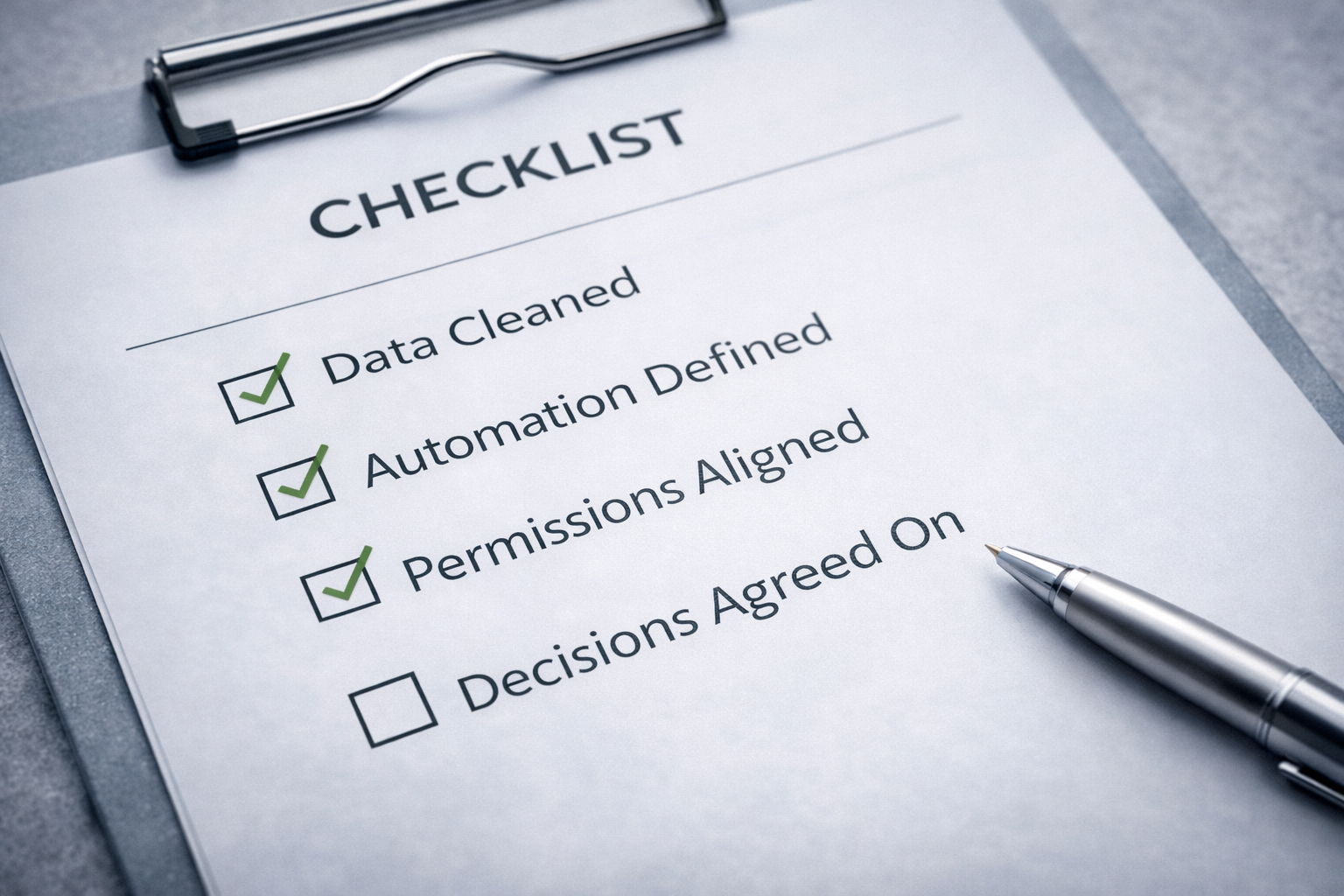
Here’s the real question: Can you trust your data today? Do your automations explain themselves? Would you let an agent act on your behalf tomorrow?
If some of those made you uncomfortable, that’s actually good news. It means you know where to start: scoping a Salesforce project before building new features.
Why Salesforce Is Ready for an Agentic Enterprise (If You Use It Intentionally)
If the previous section asked you to look inward, this is where we zoom back out and talk about the platform itself. But only if you treat it as more than a CRM.
Salesforce becomes the nervous system of the business; the place where data, decisions, humans, and agents intersect. And when that system is intentionally designed, something powerful happens: your team spends less time reacting, and your systems start anticipating.
At that point, your enterprise stops asking, “What just happened?” and starts asking, “What’s next?”
That’s the Agentic Enterprise.
And one important note before we close: while Salesforce provides powerful AI-assisted and agent-like capabilities, today’s platform operates through configured automation, predictive models, and guided intelligence, not unrestricted autonomous agents. When designed intentionally, those boundaries are not a limitation; they’re what make agentic systems trustworthy, scalable, and enterprise-ready.
And if you want help building it the right way—step by step—Dynamic Specialties Group would love to help you get there.




SHARE