

There is a moment that happens in almost every housing nonprofit. It usually unfolds in a conference room or on a Zoom call. Someone has Salesforce open. Someone else has a spreadsheet open. A third person is trying to reconcile two reports that should match, but don’t.
Eventually, someone says, “We thought Salesforce was supposed to fix this.” And to be fair, Salesforce absolutely can fix this. But only if the system is designed around how housing nonprofits actually operate. Which, as it turns out, is not a simple task.
Housing organizations aren’t just managing donor lists or volunteers. They’re managing long, complex, multi-year journeys that might begin with community outreach and move through counseling, financial education, eligibility verification, down payment assistance programs, lending services, construction initiatives, and eventually homeownership. And along the way, there are volunteers, grant requirements, compliance reports, and donor relationships layered into the same ecosystem.
When Salesforce is implemented without accounting for that operational complexity, organizations repeatedly encounter the same Salesforce integration and implementation challenges.
These issues appear across Habitat affiliates, NeighborWorks organizations, housing counseling agencies, and community development nonprofits. Different missions. Same system problems.
The Most Common Salesforce Integration Challenges for Nonprofits
Across housing nonprofits and community development organizations, the same patterns appear again and again. Salesforce is a powerful platform, but without the right architecture, it can introduce operational friction instead of clarity.
The most common Salesforce integration and implementation challenges nonprofit organizations face include:
- When Salesforce Isn’t the Operational Hub
- Salesforce Data Migration Challenges Are Often Underestimated
- Barriers to Successful Salesforce Automation
- Salesforce Testing Challenges That Appear After Launch
- Long-Term Salesforce Architecture Issues Appear Years Later
- Fragmented Client Portals Create Salesforce Integration Challenges
- Compliance Reporting Adds Another Layer of Complexity
- When Salesforce No Longer Reflects How the Organization Operates

1. Salesforce Integration Challenges: When Salesforce Isn’t the Operational Hub
One of the most common Salesforce integration challenges nonprofits face is discovering that Salesforce is only one piece of a much larger technology ecosystem.
Housing nonprofits often operate several systems simultaneously. Salesforce may track program participants and donors, while counseling activity lives in another platform. Lending programs might run in a loan origination system, and volunteer engagement may be managed through a separate portal. Grant tracking frequently lives in spreadsheets or shared drives.
Individually, each system works. Together, these different applications rarely communicate.
The result is fragmented operational visibility. A client might appear across multiple systems, but no single platform shows the full relationship between their counseling activity, grant eligibility, lending participation, and volunteer engagement.
Leadership eventually asks what sounds like a simple question: Can we see the full journey of the families we serve?
In fragmented systems, the answer is usually complicated. A Habitat for Humanity affiliate encountered this exact challenge. Volunteer coordination, homeowner applications, donor management, and grant tracking were all managed in separate tools and spreadsheets, creating major operational blind spots for leadership.
Once Salesforce was re-architected to unify these systems, the organization could finally see previously hidden relationships: volunteers who became donors, former homeowners who continued supporting the mission, and donor relationships tied to program participation.
The solution to many Salesforce implementation challenges isn’t replacing every tool. It’s designing Salesforce as the operational hub where program systems connect.
2. Salesforce Data Migration Challenges Are Often Underestimated
Every Salesforce implementation begins with the same hopeful sentence. “We’ll just migrate the data.”
Those five words hide a remarkable number of Salesforce data migration challenges.
Housing nonprofits often have years—or even decades—of historical information scattered across spreadsheets, Access databases, legacy CRM systems, donor platforms, intake forms, and shared drives. Each of those systems evolved independently to solve operational problems at the time. Unfortunately, they rarely share the same structure.
Contacts appear multiple times under slightly different names. Program records use inconsistent naming conventions. Eligibility documentation may exist entirely outside the CRM. Historical program data may be incomplete or stored in ways that do not align with modern Salesforce architecture. If that data is imported directly into Salesforce without first restructuring it, the new system simply inherits the same inconsistencies.
This challenge becomes even more complicated when organizations migrate from legacy housing platforms. One NeighborWorks organization relied heavily on the Compass-managed package before it reached the end of support. Recreating the reporting logic and program structure inside Salesforce required careful field mapping and architectural planning to preserve compliance reporting capabilities.
A successful migration is not just about moving records. It is about rebuilding the operational data model, so Salesforce accurately reflects how the organization operates today.
3. Barriers to Successful Salesforce Automation
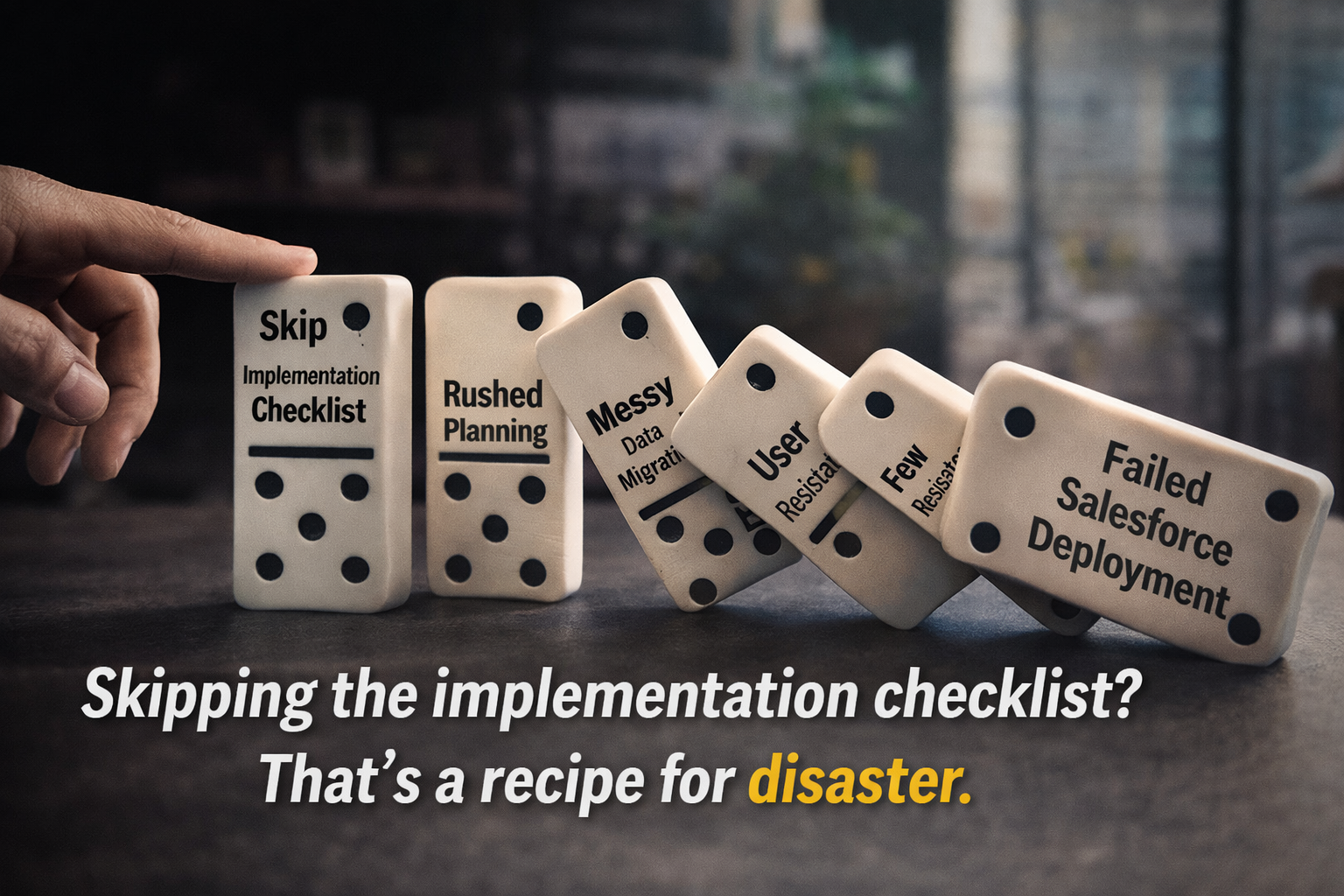
Automation is one of Salesforce’s greatest strengths. It is also one of the most common sources of long-term Salesforce implementation challenges.
Automation typically begins with helpful intentions. A workflow is created to automate client intake. Another automation handles eligibility verification. A third sends reminders about program documentation or counseling appointments. Over time, these automations accumulate.
Eventually, organizations encounter the barriers to successful Salesforce automation.
Workflows trigger in unexpected ways. Data updates occur automatically without staff understanding why. Reports become harder to explain.
In one housing counseling organization, a stabilization review uncovered more than eight hundred legacy triggers, validation rules, and automated processes accumulated over time.
Automation that once saved time had gradually become difficult to manage. The solution was not adding more automation. It was simplifying the architecture and rebuilding automation around the real program lifecycle.
Automation should quietly support operations. When it becomes too complicated to understand, it eventually becomes a liability.
4. Salesforce Testing Challenges That Appear After Launch
Another underestimated source of Salesforce implementation challenges is inadequate testing.
Most implementations include technical testing to confirm that fields update correctly, automation triggers behave as expected, and reports generate without errors.
Everything appears to work. Then the system goes live.
Real clients begin submitting documents. Staff schedule counseling appointments. Program coordinators register participants for classes. Suddenly, organizations encounter unexpected Salesforce testing challenges.
Clients may register for programs before eligibility documentation is reviewed. Documents may attach incorrectly to records. Reports may pull from incorrect data sources. These issues often appear because testing focuses on technical components rather than real-world program workflows.
One housing organization discovered that its intake workflow allowed applicants to register for paid homebuyer education classes before submitting required financial documentation. Staff were forced to untangle eligibility issues manually and issue refunds afterward.
Proper Salesforce testing must simulate the full client journey, from intake through counseling, documentation review, eligibility approval, and program enrollment. Testing systems the way real clients use them is the only reliable way to catch these issues before launch.
5. Long-Term Salesforce Architecture Issues Appear Years Later
Many organizations believe Salesforce implementation challenges appear immediately after launch. In reality, many problems appear years later.
An organization launches Salesforce successfully. Staff adopt the system. Programs run smoothly. Reports seem accurate. Over time, however, new integrations are added. Additional automation is introduced. New programs require new workflows. Eventually, the system develops what administrators sometimes describe as Salesforce Known Issues, but which are more accurately long-term architecture problems.
Reports stop reconciling consistently. Integrations quietly stop syncing data. Managed packages become outdated. Platform updates expose fragile customizations.
One housing nonprofit experienced this when a Salesforce platform update threatened to break its legacy Compass environment, putting required HUD reporting at risk. Situations like this illustrate an important reality. Salesforce implementations require ongoing governance and periodic architecture reviews to remain stable.
How to Tell When Salesforce Implementation Challenges are Starting to Appear
One of the most difficult aspects of diagnosing Salesforce implementation challenges is that problems rarely appear all at once. Instead, they emerge gradually.
At first, everything seems fine. The system launches. Staff begin using it. Reports appear to work. Leadership feels confident that the organization finally has a unified CRM. Then, small warning signs start to appear. Someone mentions that a report needs “a little cleanup” before it can be shared with the board. A program manager quietly maintains a spreadsheet because it’s easier than entering data into Salesforce. A counselor says they cannot find the client information they need without checking another system.
None of these issues seems catastrophic on its own. But taken together, they are often early indicators that a Salesforce implementation is drifting away from how the organization actually operates.
Housing nonprofits experiencing Salesforce integration challenges often notice consistent patterns. Staff rely on spreadsheets again because Salesforce workflows feel too complicated. Reports require manual adjustments before they can be shared externally. Different departments maintain their own versions of program data because they do not trust the central system. Over time, the CRM stops being the system of record.
Eventually, someone asks the question that reveals the underlying problem. Which numbers are correct? When that question becomes difficult to answer, it usually means the organization is facing deeper Salesforce implementation challenges related to system architecture, automation, or data structure.
6. Fragmented Client Portals Create Salesforce Integration Challenges
Housing nonprofits frequently run multiple programs simultaneously. Counseling services, lending programs, education classes, grants, and housing construction initiatives may all operate at the same time.
As organizations expand, separate portals are sometimes created for different services.
Clients might upload financial documentation through one portal, schedule counseling appointments through another system, and register for classes somewhere else entirely.
From the client’s perspective, the experience becomes confusing.
From the organization’s perspective, it creates additional Salesforce integration challenges because each portal captures different pieces of the client journey. Unified client portals that integrate directly with Salesforce can dramatically improve both the client experience and data accuracy.
7. Compliance Reporting Adds Another Layer of Complexity
Housing nonprofits operate within a highly regulated environment. Organizations frequently report to multiple stakeholders simultaneously, including HUD housing counseling programs, NeighborWorks America, state housing authorities, philanthropic grant funders, and municipal governments.
Each stakeholder may require different reporting formats, metrics, and timeframes.
Without carefully structured Salesforce reporting frameworks, staff often export data to spreadsheets to manually reconstruct compliance reports. That creates yet another layer of Salesforce implementation challenges.
When Salesforce architecture is designed specifically around compliance requirements, reporting becomes significantly more reliable and much less time-consuming.
8. When Salesforce No Longer Reflects How the Organization Operates
The final—and perhaps most subtle—Salesforce implementation challenge occurs when the system itself becomes outdated.
Nonprofits evolve, programs expand, funding models change, and new services get introduced.
But Salesforce implementations rarely evolve at the same pace. Over time, the system no longer reflects how the organization actually operates.
Staff create workarounds, data entry becomes inconsistent, and reports lose credibility. At that point, restoring trust in the system requires revisiting the architecture and redesigning workflows, so Salesforce once again supports the full lifecycle of housing programs.
How Dynamic Specialties Group Helps Housing Nonprofits Solve These Challenges
Dynamic Specialties Group has a deep focus specifically on housing nonprofits and community development organizations. These organizations manage programs that include housing counseling, financial education, down payment assistance, lending initiatives, home construction, and neighborhood revitalization. Their operational systems must track complex client journeys while supporting regulatory reporting requirements and grant funding accountability.
DSG helps organizations stabilize and modernize their Salesforce environments so the system becomes a reliable operational platform rather than a source of frustration. This work often involves repairing fragile Salesforce architectures, simplifying automation, rebuilding reporting frameworks, integrating fragmented systems, and redesigning workflows so staff actually use the system again.
A big part of that work begins before any technical changes are made. DSG takes the time to understand how an organization actually operates today: how programs move from intake to counseling, how data flows between departments, and where staff are forced to rely on workarounds just to keep things moving. That process of discovery is critical because housing nonprofits rarely operate like a standard CRM model.
From there, the goal isn’t just to align Salesforce with how the organization works today, but to design the system so it can support how the organization wants to grow tomorrow. Programs evolve, funding models change, and reporting requirements expand. Building Salesforce with scalability in mind helps ensure the platform can grow alongside the organization instead of becoming another constraint.
That combination—taking the time to truly understand a client’s business and designing systems that support both current operations and future growth—is what sets Dynamic Specialties Group apart as a Salesforce partner for housing nonprofits.
The goal is not simply to implement software; it’s to restore confidence in the organization’s data.
The Real Purpose of Salesforce in Housing Nonprofits
At its best, Salesforce does far more than manage contacts. It helps organizations understand the communities they serve.
When Salesforce is implemented correctly, housing nonprofits gain visibility into the full journey of the families they support, from financial counseling to homeownership and beyond. That clarity allows organizations to operate more efficiently, demonstrate measurable impact to funders, and ultimately help more families achieve stable housing, which is exactly what the technology was meant to support all along.
Evaluating How Your Salesforce System Supports Your Mission
If your organization is navigating some of these challenges, you’re not alone. Many housing nonprofits eventually reach a point where their systems no longer reflect how their programs actually operate.
Taking the time to step back and evaluate how Salesforce supports your workflows, reporting, and client journeys can reveal opportunities to simplify operations and improve visibility. Conversations with peers, system assessments, or even small architecture reviews often uncover practical improvements that make the platform far more useful for staff and leadership alike.






SHARE