

If you've ever remodeled a house, you already understand the basic difference between Salesforce configuration vs. customization, even if you've never heard those terms before. Changing the paint color? Configuration. Replacing the light fixtures? Still configuration. Knocking out a load-bearing wall because you really want an open-concept kitchen? That's customization.
Both have their place. But while one is relatively easy to reverse, the other requires architects, contractors, and a healthy respect for what happens when you remove the wrong wall. The same thing happens inside Salesforce.
One of the most common conversations we have with nonprofit organizations starts with a client saying, "We think we need customization." More often than not, what they actually need is thoughtful configuration. Others assume Salesforce can't support their unique programs without custom code, even though the platform already includes tools that do exactly what they're trying to do.
Understanding the difference isn't just a technical exercise. It affects implementation costs, project timelines, long-term maintenance, user adoption, and how easily your organization can benefit from future Salesforce seasonal releases. Choose wisely, and your CRM quietly supports your mission for years. Choose poorly, and you may find yourself maintaining yesterday's decisions long after they've stopped making sense.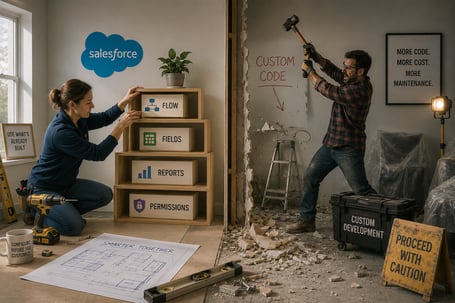
Why Salesforce Configuration vs. Customization Matters
For many nonprofit leaders, configuration and customization sound like two ways of describing the same thing. After all, both involve tailoring Salesforce to fit your organization's needs. But they aren't interchangeable.
Salesforce configuration generally helps organizations move faster, reduce implementation costs, simplify ongoing administration, and stay aligned with new platform capabilities.
Salesforce customization can unlock functionality configuration can't provide—but it also adds complexity, ongoing maintenance, and long-term technical debt. For most nonprofits, configuration should be the starting point for nearly every Salesforce implementation.
That's why experienced Salesforce consulting partners don't begin projects by asking, "What do you want to customize?" They start with a much better question: "What business problem are we actually trying to solve?" Sometimes the answer is configuration; other times, it's custom development. And once in a while, it's rethinking a business process that no longer serves the organization.

What Is Salesforce Configuration?
Salesforce configuration is the process of tailoring Salesforce using declarative, low-code tools instead of custom code. That includes creating custom fields, building reports and dashboards, configuring page layouts, managing security with permission sets, creating validation rules, building Salesforce Flow automations, creating approval processes, and even creating custom objects—which, despite the name, are still configuration rather than customization.
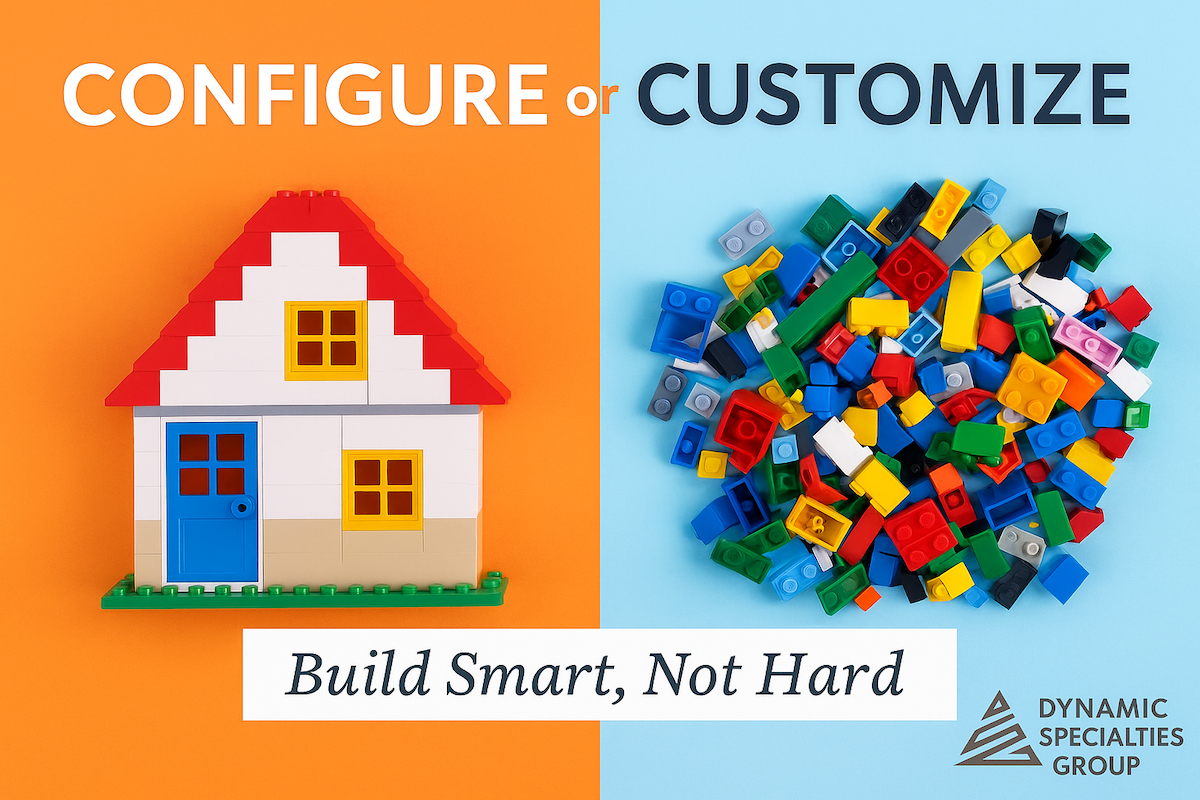
Think of configuration as assembling an incredibly sophisticated LEGO set. You're using the pieces Salesforce already provides and combining them in ways that support your organization's mission. You aren't manufacturing new bricks. You're building something unique with the ones already in the box.
For many nonprofits, that's more powerful than it sounds. Need to track volunteers alongside donors? Configuration. Need separate fundraising and program management workflows? Configuration. Need housing case managers to see different information than your development team? Configuration. Need automated grant approvals, donor acknowledgments, or executive dashboards that update automatically? Configuration again.
One of the biggest misconceptions we encounter is that unique business requirements automatically require custom development. That might have been true years ago. Today, Salesforce's declarative capabilities have evolved dramatically.
Salesforce Flow has become the platform's central tool for declarative automation. Dynamic Forms can display fields and sections based on record data, user details, and other visibility criteria. At the same time, Dynamic Related Lists allow administrators to filter and tailor the related records users see. Reports, dashboards, approval processes, Screen Flows, permission sets, custom objects, and countless other low-code capabilities continue to eliminate scenarios that once required developers.
Salesforce's AI capabilities continue pushing that boundary further. Agentforce provides tools for creating AI agents, while Einstein features and Prompt Builder can summarize information, generate content, guide users, and support automated work using CRM and other approved data. Depending on the use case, these capabilities can reduce—but not always eliminate—the need for custom development.
The broader trend is clear: Salesforce's seasonal releases continue expanding what organizations can accomplish through declarative configuration and low-code tools. That doesn't mean customization is unnecessary. It simply means the smartest Salesforce implementations start by seeing how far configuration can take you before reaching for custom code.
What Is Salesforce Customization?
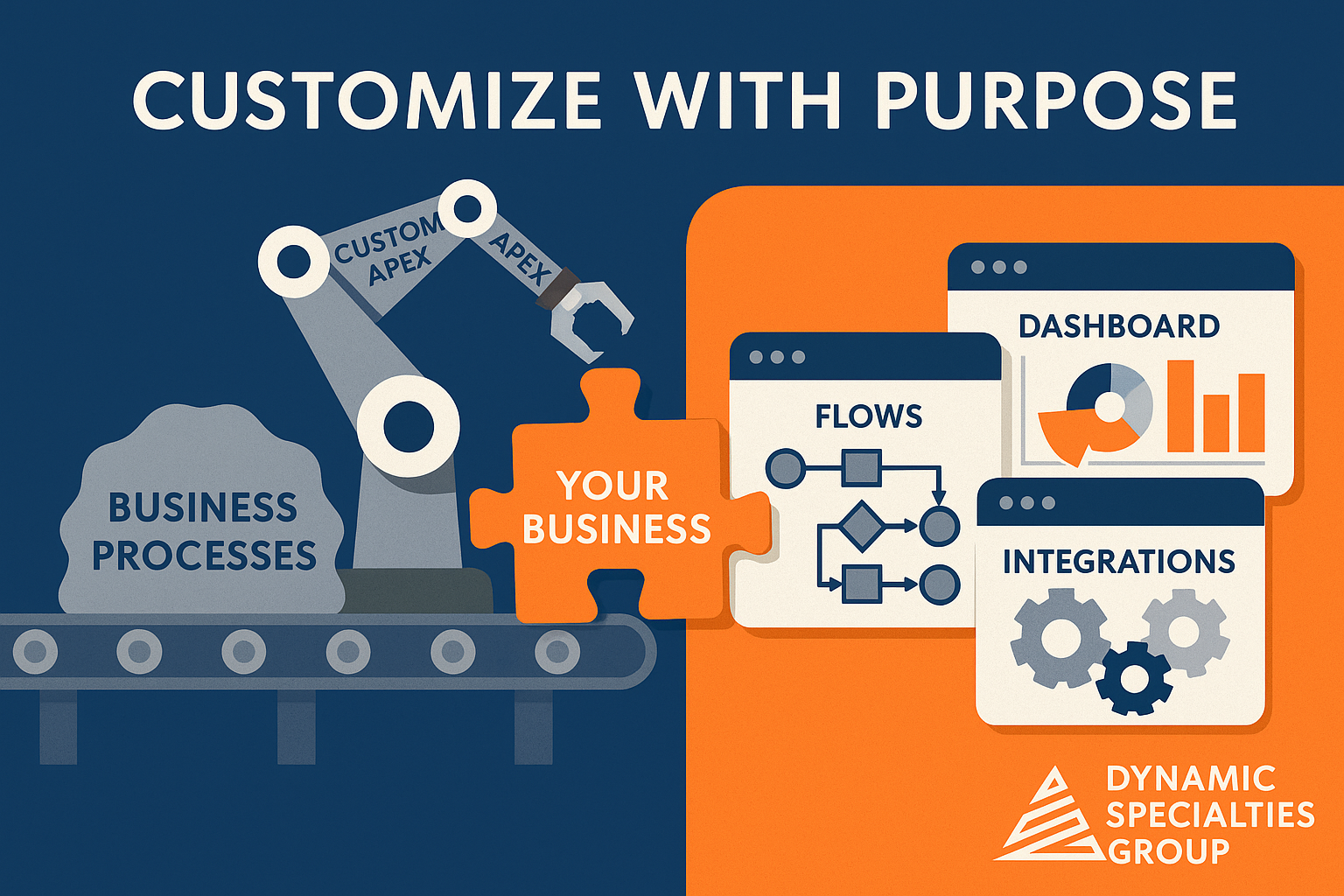
If configuration means working creatively with the pieces Salesforce already provides, Salesforce customization means creating something the standard platform doesn't. This can include writing Apex code, building Lightning Web Components, developing custom API integrations, or creating specialized functionality for business requirements that declarative tools can't reasonably address.
Going back to our house analogy, configuration is choosing the cabinets, moving the furniture, and installing a smart thermostat. Customization is calling the contractor.
Sometimes that's exactly what you need. If your nonprofit has a genuinely unique operational requirement, a complex integration, or functionality that simply isn't available through standard Salesforce capabilities, custom development can be the right investment. But you probably wouldn't hire a contractor to move the couch.
The same principle applies to Salesforce. Custom development should solve a genuine business problem, not recreate functionality Salesforce already provides or preserve a process simply because "that's how we've always done it."
Why "We've Always Done It This Way" Leads to Unnecessary Salesforce Customizations
There may be no five words more expensive during a CRM implementation than: "We've always done it this way." A nonprofit might have a fifteen-step grant approval process because that's how its previous system worked. Program staff may want Salesforce screens to look exactly like spreadsheets they've used for years, or a development team may request a custom workflow because everyone has become accustomed to manually moving information from one place to another.
Sometimes the answer is yes, and Salesforce should accommodate an important business requirement. Other times, discovery reveals that a supposedly essential process exists because of a limitation in an old CRM, a spreadsheet someone created eight years ago, or a workaround nobody remembers creating in the first place. In those situations, customizing Salesforce to reproduce the old process doesn't solve the problem; it preserves it. That's why good Salesforce solution design starts with the business requirement and works backward to the technology, not the other way around.
Salesforce Configuration vs. Customization: Which Is Better for Nonprofits?
So, which is better for nonprofits: Salesforce configuration or customization? Neither—at least not universally. The better approach is the simplest solution that fully addresses the business requirement and can be responsibly maintained over time.
For most nonprofits, that means starting with configuration. Well-designed declarative Salesforce solutions are generally easier to administer, maintain, and evolve as the organization grows. They can also reduce the amount of specialized development expertise required to make future changes. But "configuration first" shouldn't become "configuration at all costs."
There are legitimate situations where custom development is the better architectural decision. Forcing an unusually complex requirement into layers of Flows, formulas, and workarounds just to avoid writing code can create its own kind of technical debt. The goal isn't to win a prize for having the least custom code; it's to build the right Salesforce environment for the organization.
That's why we look at the underlying business problem before deciding how Salesforce should solve it. Sometimes the answer is standard functionality. Sometimes it's a thoughtful configuration. Sometimes custom development genuinely earns its place. The important part is making that decision intentionally because the question isn't really configuration versus customization; it's how much complexity does this problem actually deserve?
When Salesforce Customization Makes Sense
So, when does customization actually earn its place? Usually when your nonprofit has a legitimate business requirement that Salesforce's standard and declarative capabilities can't reasonably solve.
A housing organization might need a complex integration with a property management or government reporting system. A nonprofit with a specialized service-delivery model may need functionality that doesn't exist on the standard platform. Another organization might have sophisticated data-processing or user-experience requirements where custom development provides a cleaner, more maintainable solution than piling workaround on top of workaround.
In those situations, customization isn't the villain—it's the right tool for the job. We've seen organizations approach Salesforce assuming they need extensive custom development, only to discover during requirements and discovery that much of what they want can be handled through configuration and Flow. That can mean a simpler implementation and an environment that's easier to support.
But we've also seen the opposite: a requirement where forcing everything into declarative tools would create more complexity than carefully designed custom development. That's the point. The goal isn't to avoid customization. It's to make sure customization earns its way into the solution.
The Hidden Cost of Salesforce Customization: Technical Debt
Custom functionality still requires attention after implementation ends. Custom Apex, Lightning Web Components, integrations, and other specialized functionality may need ongoing testing, documentation, monitoring, troubleshooting, and updates as Salesforce, connected systems, and your organization's requirements evolve. That's where technical debt enters the conversation.
Technical debt is the future cost and complexity that can accumulate as technology decisions, shortcuts, and older solutions become harder to maintain or no longer fit the organization's needs. And despite the name, it isn't limited to custom code. Poorly designed Flows, duplicated automation, unnecessary metadata, outdated integrations, and overly complicated configuration can create technical debt too.
Think of it like a nonprofit's storage closet. One box labeled "We'll deal with this later" isn't much of a problem. But ten years later, you're standing in front of 47 mystery boxes, three obsolete printers, and a banner from the 2014 gala, wondering how opening the door became a strategic initiative. Salesforce environments can accumulate complexity the same way. That's why the real objective isn't simply minimizing custom code. It's minimizing unnecessary complexity.
A thoughtful customization that solves an important requirement and is properly documented may be far more sustainable than an elaborate collection of workarounds designed solely to avoid development. The question isn't just, "Can we build this?" It's also, "Who is going to maintain it?"
Salesforce Configuration vs. Customization: Common Myths
A few misconceptions tend to follow the configuration-versus-customization conversation, so let's clear them up.
Myth: Every nonprofit needs a highly customized Salesforce org.
Not necessarily. Nonprofits may have unique missions and operating models, but many common requirements can be addressed through Salesforce's standard and declarative capabilities. Customization should be driven by actual requirements, not the assumption that nonprofit automatically means "custom."
Myth: Custom code is always more powerful, so it's the better solution.
Custom development can provide capabilities and flexibility that declarative tools can't. But more flexibility doesn't automatically make something better. The right solution considers maintainability, scalability, security, performance, user experience, supportability, and the organization's ability to sustain it over time.
Myth: Configuration is only for simple organizations.
Definitely not. Declarative tools can support sophisticated business processes, and configuration is an important part of even complex Salesforce environments. The question isn't whether your nonprofit is "too complicated" for configuration. It's whether configuration is the appropriate tool for a particular requirement. And that's really the theme running through this entire conversation: configuration isn't automatically good, customization isn't automatically bad, and complexity isn't necessarily a problem. But unnecessary complexity is an issue.
How to Decide Between Salesforce Configuration and Customization
By this point, the obvious question is: how do you know which approach your nonprofit actually needs? Before requesting customization, start with three questions:
- Can Salesforce already solve this through standard functionality, configuration, or an appropriate existing solution?
- Are we solving a genuine business requirement or preserving an old process?
- Will this solution still make sense as our organization grows?
Those questions sound simple, but they can prevent a surprising amount of unnecessary complexity. The answer isn't always configuration. Sometimes a requirement genuinely calls for custom development. But starting with the business need—and evaluating the simplest maintainable solution first—helps keep technology decisions tied to organizational value rather than technical possibility. Because "Can Salesforce do this?" and "Should we build it this way?" are two very different questions.
Build Salesforce for Tomorrow, Not Yesterday
Your nonprofit isn't standing still. Programs expand, fundraising strategies change, reporting requirements evolve, new systems enter the picture, teams grow, leadership changes, and sooner or later someone asks Salesforce to do something nobody imagined during the original implementation. That's why a good Salesforce implementation shouldn't be designed only around the organization you are today. It should leave room for the organization you're becoming.
That doesn't mean predicting every requirement five years in advance. In fact, attempting to build for every imaginable future scenario can create exactly the kind of complexity we've been talking about. It means making intentional decisions now that preserve flexibility later.
That's a big part of how we approach Salesforce solutions for nonprofits. We start by understanding the business problem, look for opportunities to use standard Salesforce functionality and thoughtful configuration, and recommend customization when the requirement genuinely justifies it. Sometimes that means building something new or simplifying something old. And sometimes the most valuable thing we can say is, "You don't actually need to customize that."
That's not about doing less. It's about building what your organization actually needs—and making sure someone can still understand, support, and evolve it years from now.
Choosing the Right Salesforce Approach for Your Nonprofit
Remember the house we were remodeling at the beginning? Nobody wins an award for knocking down the most walls. They build a space that works for the people living in it today without making tomorrow's renovation unnecessarily difficult. Salesforce should work the same way.
The best nonprofit CRM isn't the one with the most custom code—or the least. It's the one that quietly supports fundraising, programs, reporting, operations, and growth without becoming a burden in its own right. And that could be either configuration or customization depending on the situation. Knowing the difference—and knowing when each one has earned its place—turns a Salesforce implementation into a long-term Salesforce strategy. And that's ultimately the goal: a Salesforce environment that supports your mission instead of becoming another mission to manage.



SHARE