
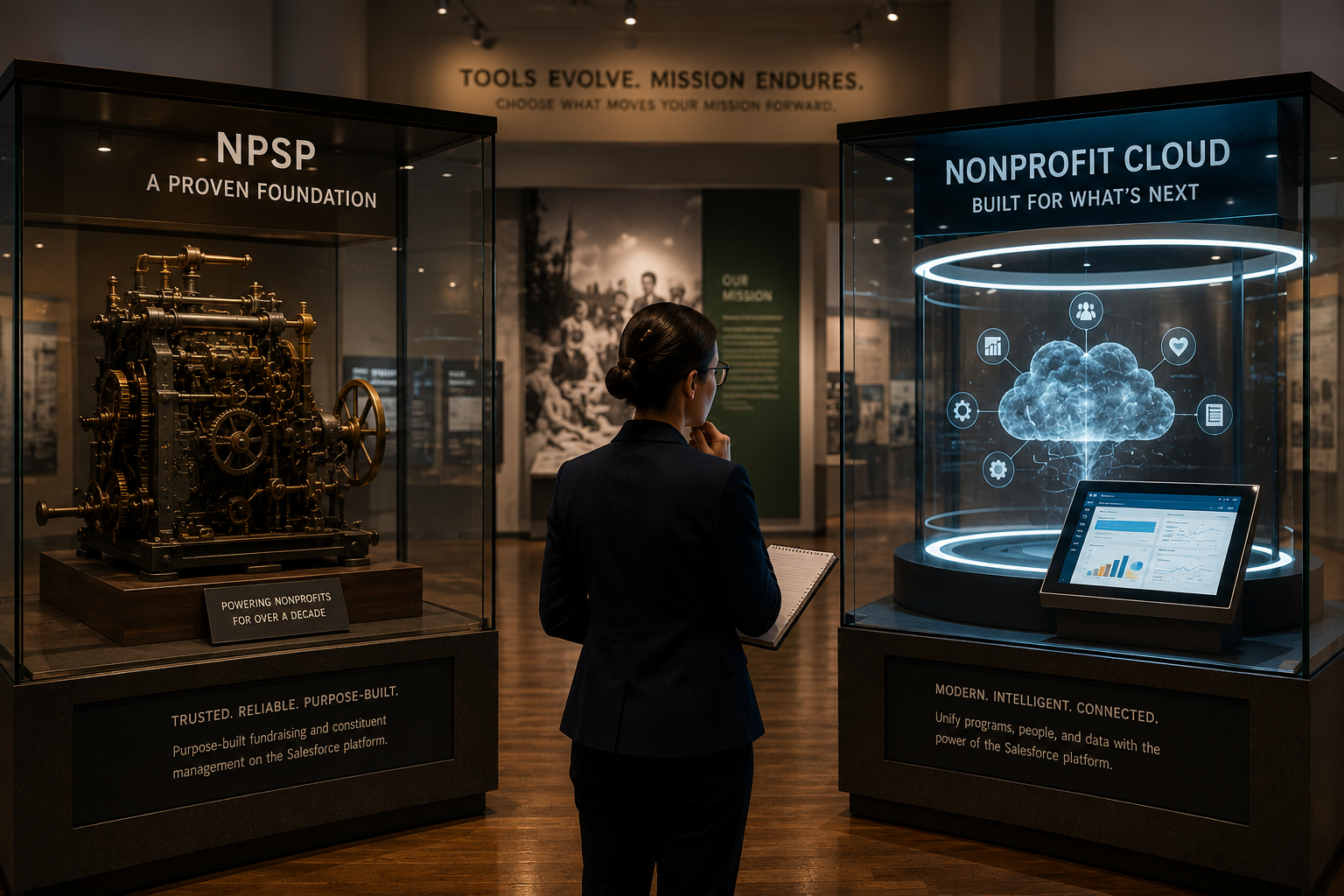
Picture a nonprofit executive weaving through the expo hall at a technology conference. Every keynote mentions artificial intelligence before the coffee has finished brewing. Every software vendor promises to transform your mission. Every booth flashes phrases like AI agents, intelligent automation, Data Cloud, and the future of nonprofit operations.
Then someone asks, "So, are you still on NPSP?" It's remarkable how one innocent question can derail an otherwise enjoyable afternoon.
Within minutes, someone says their organization is evaluating Salesforce Nonprofit Cloud (aka Agentforce Nonprofit). Another attendee insists Salesforce is replacing the Nonprofit Success Pack (NPSP). Someone else throws Agentforce into the conversation. Before long, you're wondering whether you somehow missed a major announcement. If that sounds familiar, you're not alone.
Across the nonprofit sector, executive directors, development leaders, IT teams, and board members are hearing more about Salesforce Nonprofit Cloud, Agentforce, Data Cloud (aka Data 360), and AI than ever before. At the same time, thousands of organizations continue relying on NPSP—the trusted Salesforce solution that has powered fundraising and constituent management for well over a decade.
So the questions naturally follow. Should you stay on NPSP? Should you begin planning a migration? Is Salesforce quietly encouraging nonprofits to move away from it? The answer is refreshingly straightforward: Maybe. And perhaps that’s not exactly the definitive answer you were hoping for, but it's the honest one.
We've found that successful Salesforce initiatives rarely begin by asking which platform has the newest capabilities. They begin with a much more important question: What does our organization actually need to accomplish? That's the conversation worth having.
Choosing between NPSP and Salesforce Nonprofit Cloud isn't about chasing the latest product announcement. It's about selecting the platform that best supports your mission today while positioning your organization for tomorrow. Before comparing the two, though, let's clear up the biggest misconception surrounding this discussion.
Salesforce Still Supports NPSP
Let's address the rumor that's been making the rounds in conference hallways, webinars, and more than a few LinkedIn comment sections. Salesforce has not announced an end-of-life or retirement date for NPSP. If your organization uses NPSP today, there's no reason to panic. You don't need an emergency migration plan, and you certainly shouldn't assume that your Salesforce investment has suddenly become obsolete.
Organizations running NPSP continue to receive support, maintenance updates, security fixes, and compatibility updates where appropriate. For many nonprofits, NPSP remains a stable, dependable platform for fundraising and constituent management. At the same time, Salesforce's newest nonprofit innovation centers on Salesforce Nonprofit Cloud and the broader Salesforce platform, including technologies such as Agentforce, Flow, Data Cloud, and AI-assisted automation.
Those two realities aren't contradictory. NPSP remains supported. Nonprofit Cloud is where Salesforce is making many of its long-term platform investments. Once you understand that distinction, the conversation changes. Instead of asking, "Is Salesforce forcing us to migrate?" the better question becomes: "Does our organization have a compelling business reason to evaluate something new?" That's where thoughtful technology planning begins.

How Salesforce Got Here
For years, Salesforce NPSP helped redefine what a nonprofit CRM could be. It gave organizations a purpose-built way to manage donors, households, recurring gifts, campaigns, relationships, and fundraising operations on the Salesforce platform. Thousands of nonprofits built successful development programs with NPSP, and many continue to do so today. But nonprofits have changed.
A decade ago, many organizations viewed Salesforce primarily as a fundraising platform. Today, they expect it to support far more than just development teams. Program managers want outcome reporting; grant managers need better visibility into funding and compliance; executive leaders expect dashboards that connect operational performance with organizational strategy; and staff want repetitive administrative work automated so they can spend more time serving constituents. And increasingly, nonprofit leaders are exploring how AI can improve efficiency without sacrificing governance, trust, or mission focus.
Those expectations extend well beyond the original scope of NPSP. Rather than continuing to expand NPSP indefinitely, Salesforce introduced Nonprofit Cloud—a modern solution built on Salesforce's industry data model and designed to leverage innovation across the broader Salesforce platform. Depending on an organization's implementation, licensing, and priorities, those capabilities can extend to fundraising, program management, constituent engagement, automation, analytics, and AI-assisted experiences, enabled by technologies such as Agentforce and Data Cloud.
That doesn't mean every nonprofit should migrate; it simply means nonprofits now have another option to evaluate.
Salesforce Nonprofit Cloud Isn't "NPSP 2.0"
It's tempting to think of Salesforce Nonprofit Cloud as the next version of NPSP—as though upgrading is as simple as installing the latest version of your favorite software—and this is where many conversations become oversimplified, because that's not how it works.
Salesforce Nonprofit Cloud isn't an upgraded edition of NPSP. It's a modern platform built on Salesforce's industry data model, designed to support a broader range of nonprofit operations while benefiting from continued innovation across the Salesforce ecosystem. Depending on your organization's implementation, licensed products, and business objectives, Nonprofit Cloud can support fundraising, program management, constituent engagement, grant-related workflows, analytics, automation, and AI-assisted experiences through Agentforce and other Salesforce technologies.
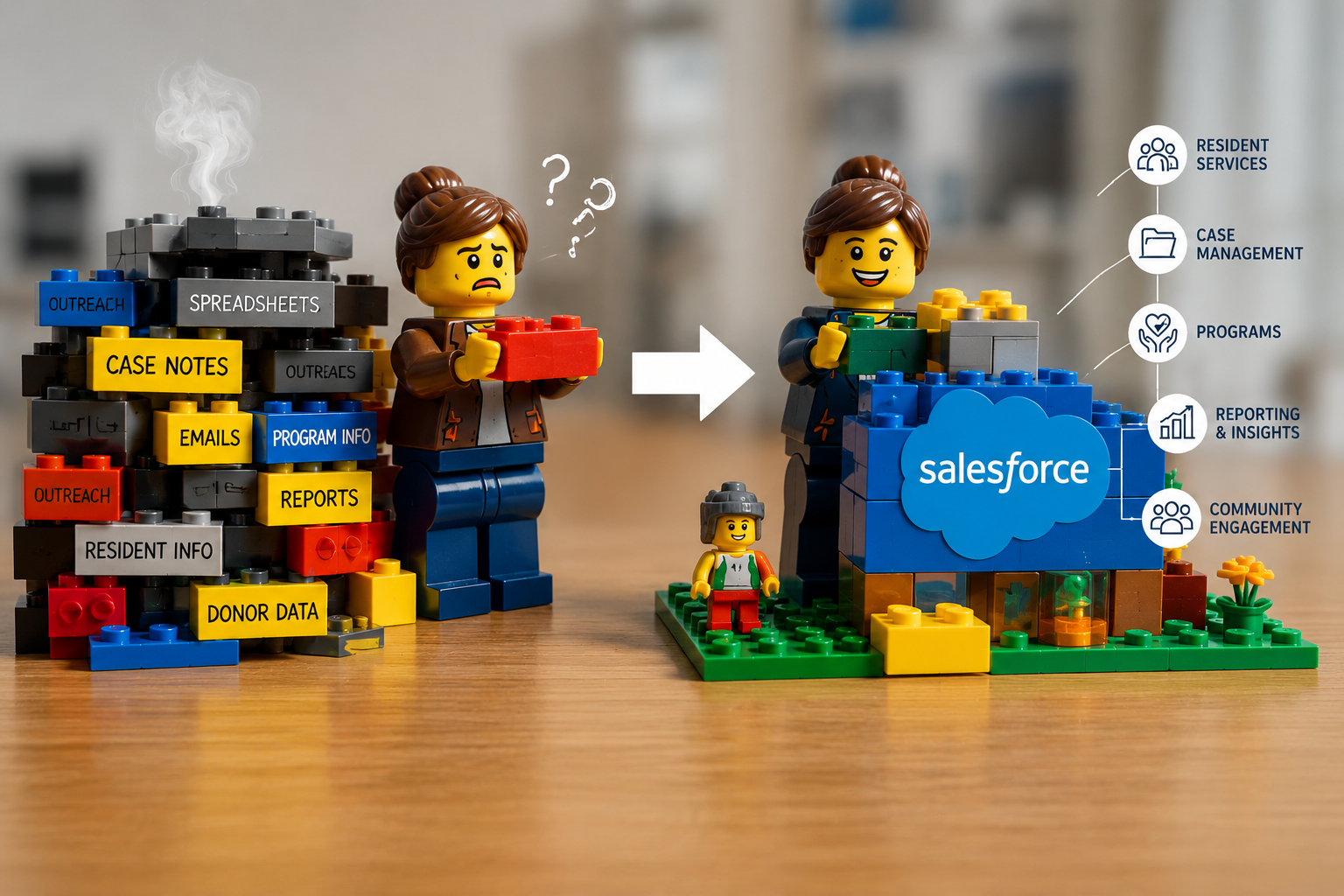
That's an important distinction because moving from NPSP to Nonprofit Cloud is not a traditional software upgrade. Rather, it's better to think of it as a strategic reimplementation. The underlying data models differ, business processes often need to be reassessed, and reports and dashboards typically require redesign. Moreover, integrations should be reviewed, users need training, and governance becomes even more important.
None of that should discourage organizations from considering Nonprofit Cloud. However, it does reinforce an important reality: A successful migration isn't primarily a technology project; it's an organizational change initiative, and organizational change deserves thoughtful planning.
The Question Most Organizations Should Be Asking
By now, you may have noticed something interesting: We haven't spent much time comparing features, and that's intentional. Too many Salesforce conversations begin with product checklists. "This platform has AI." "That one uses a different data model." "This one offers more automation." Those comparisons have their place, but only after you've answered a much more important question: What problem are you actually trying to solve?
Technology should support your strategy, not become the strategy itself. We've worked with organizations convinced they needed an entirely new Salesforce environment. After a few discovery sessions, a different story emerged. Their biggest obstacles weren't the platform. Rather, they were inconsistent business processes, duplicate data, disconnected spreadsheets, outdated governance, and limited user adoption. And by addressing those issues first, they improved reporting, increased efficiency, and restored user confidence without migrating to a new platform.
We've also worked with nonprofits whose growth had genuinely outpaced their existing implementation. They needed a more scalable foundation to support increasingly sophisticated fundraising, program delivery, grant management, constituent engagement, and executive reporting. For those organizations, evaluating Salesforce Nonprofit Cloud made strategic sense.
Spoiler alert: the difference wasn't the software; it was the organization's evolving needs. That's where every conversation about NPSP versus Salesforce Nonprofit Cloud should begin.
What's Changed in Salesforce and What Hasn't
Despite all the excitement surrounding AI, automation, and the latest Salesforce announcements, the fundamentals of nonprofit work remain remarkably consistent. Your organization still needs to cultivate donors, manage campaigns, steward volunteers, meet grant requirements, measure outcomes, and provide leadership with reliable information to support strategic decision-making.
For many organizations, Salesforce has evolved from a fundraising platform into the operational hub for the entire organization, and development teams are no longer the only stakeholders. Program managers need visibility into service delivery, executives want reporting that connects fundraising performance with mission outcomes, and staff want repetitive administrative work automated so they can spend more time serving constituents. That's where Salesforce Nonprofit Cloud begins to distinguish itself.
Built on Salesforce's modern industry data model, it enables organizations to integrate fundraising, program operations, analytics, automation, and AI-assisted capabilities into a broader operational framework. That doesn't mean every nonprofit needs every one of those capabilities. In short, successful technology decisions are rarely driven by product announcements; organizational priorities drive them.
Don't Make Salesforce Strictly an IT Project
It's easy for a Salesforce evaluation to become consumed by software demonstrations, feature comparisons, architecture diagrams, and technical discussions. Before long, everyone is debating functionality while almost no one is talking about the organization's mission—and that's backward.
If leadership can't clearly explain how a new platform will improve fundraising, strengthen constituent relationships, simplify operations, or better support the communities they serve, it may not be the right time to migrate. That’s because technology alone rarely solves organizational challenges. Strong governance, clean data, well-designed business processes, thoughtful automation, and user adoption do.
That's why successful Salesforce initiatives begin with discovery, not recommendations. Before discussing products, organizations should understand where they are today, where they want to go, and what's preventing them from getting there. Only then can they determine whether optimization, expansion, or migration is the right next step.
Two Organizations. Two Different Answers.
Consider a regional food bank. Its development team knows Salesforce NPSP inside and out; donations are processed efficiently; campaign reporting is reliable; board reports are generated without late-night spreadsheet marathons; staff trusts the data because years have been invested in refining processes; and leadership has confidence in the information used to make decisions.
Could the organization migrate? Absolutely. Does it need to? Maybe not. If fundraising, donor stewardship, and maintaining a stable, well-adopted CRM remain its primary priorities, continuing with NPSP may be the right decision for the foreseeable future.
Now consider a nonprofit providing affordable housing, workforce development, financial counseling, and behavioral health services across multiple communities. Fundraising is only one piece of its mission. Leadership wants a unified view of constituent engagement across programs. Program managers need standardized outcome reporting. Service teams want consistent workflows. Executives are exploring AI-assisted capabilities that reduce administrative work and give staff more time to focus on the people they serve.
That organization isn't necessarily "too big" for NPSP; it's simply managing a greater operational complexity. For an organization like that, evaluating Salesforce Nonprofit Cloud may be a logical next step, not because NPSP has failed, but because its mission, operations, and long-term goals have evolved.
The lesson is simple. The latest Salesforce release doesn't determine the right platform. Rather, it's determined by the work your organization needs Salesforce to do.
The Biggest Salesforce Migration Myth
If there's one misconception we'd like to retire, it's this: "Every nonprofit should migrate to Salesforce Nonprofit Cloud as soon as possible." Simply put, the facts don't support that.
Many nonprofits continue to run highly successful fundraising and constituent management operations on NPSP. Their users are productive. Leadership trusts the data. Integrations remain reliable. Salesforce is helping them fulfill their mission exactly as intended. Those organizations aren't falling behind; they're using a platform that continues to meet their needs.
At the same time, organizations shouldn't dismiss Salesforce Nonprofit Cloud simply because their current environment is working. The real question isn't whether your Salesforce org functions today. It's whether it can support where your organization wants to be tomorrow, and that's an entirely different conversation.
One focuses on preserving what already works. The other asks whether your technology can support future growth, increasing operational complexity, and evolving strategic priorities. The nonprofits that make the strongest technology decisions spend less time asking, "What's Salesforce releasing next?" and more time asking, "What capabilities will help us better serve our constituents over the next three to five years?" That's the mindset that leads to smarter long-term investments.
The Cost of Salesforce Migration Is About More Than Software
One of the first questions nonprofit leaders ask when evaluating Salesforce Nonprofit Cloud is, "How much is this going to cost?" It's an important question, but software licensing is only one part of the answer.
Many eligible nonprofits participate in Salesforce's Power of Us Program, which can significantly reduce licensing costs. Beyond licensing, however, every successful implementation or migration includes work that rarely appears on a pricing sheet: discovery workshops, business process analysis, data assessment and cleanup, configuration, integration reviews, testing, training, and change management. Those activities often determine whether a Salesforce initiative delivers lasting value or becomes another underused technology project.
And there's another investment that's just as important: time. Every major technology initiative competes for the same limited organizational resources. While project teams are planning a migration, they're also balancing fundraising campaigns, grant reporting, volunteer coordination, program delivery, and countless other priorities. That's why migration shouldn't be evaluated only in terms of cost; it should be evaluated in terms of outcomes. Will it improve executive reporting? Will it create a better constituent experience? Will it simplify operations? Will it give staff more time to focus on mission-driven work? Will it support where the organization is headed over the next several years?
When those answers are clear, the investment becomes much easier to justify because technology is the investment and mission impact is the return.
Before You Decide, Ask These Five Questions
The purpose of this article isn't to convince every nonprofit to adopt Salesforce Nonprofit Cloud.
It's to help you make an informed decision. Before beginning any serious evaluation, we encourage leadership teams to ask five questions.
1. Is our current Salesforce environment helping us achieve our strategic goals?
Every platform has limitations. The more important question is whether those limitations are preventing your organization from moving forward. If staff trust the data, users are productive, leadership gets the reporting it needs, and Salesforce continues to support your mission, your current environment may still be the right fit.
2. Are our biggest challenges really technology problems?
Many organizations discover that their greatest obstacles have little to do with software.
Inconsistent business processes, duplicate records, disconnected spreadsheets, limited governance, and insufficient user training often create more friction than the platform itself.
Replacing software rarely fixes those issues. Improving how your organization uses Salesforce often does.
3. Will newer capabilities create meaningful business outcomes?
Artificial intelligence, automation, Agentforce, and Data Cloud are exciting technologies, but they should solve real business problems—not simply add new features. It's also worth thinking beyond today's needs. If your organization expects significant growth, plans to expand services, or anticipates greater operational complexity over the next several years, now may be the right time to begin building a long-term Salesforce roadmap, even if migration isn't an immediate priority. Planning ahead is very different from rushing ahead.
4. Is our data ready?
Whether you remain on NPSP or eventually adopt Salesforce Nonprofit Cloud, the quality of your Salesforce environment will always depend on the quality of your data. Poor data doesn't disappear during a migration. Instead, it follows you into the new system. Organizations that invest in data quality, governance, and user adoption consistently see better long-term results regardless of which Salesforce platform they choose.
5. Do we have the organizational capacity to make this successful?
Technology initiatives don't happen in a vacuum, and sometimes the smartest decision isn't what to do; it's when to do it. Recognizing when your organization is ready for meaningful change—and when strengthening your existing Salesforce environment will deliver greater value—is an important part of good governance and long-term planning.
The Best Salesforce Option Is the One That Helps You Deliver Your Mission
Let's go back to the nonprofit executive from the beginning of our story. They're still walking the conference floor, the AI demonstrations are still impressive, the product announcements are still exciting, and the buzz around Agentforce, Data Cloud, and the latest Salesforce innovations hasn't slowed down. But something has changed. Instead of wondering whether they're falling behind, they're asking better questions.
What challenges are we actually trying to solve? Will this help our staff spend more time serving our constituents? Are we making this decision because our organization genuinely needs it, or because everyone else seems to be talking about it?
Those are the questions that lead to smart technology decisions. The choice between Salesforce NPSP and Salesforce Nonprofit Cloud isn't about keeping up with the latest release. It's about selecting the platform that best supports your mission, your people, and the work your organization needs to accomplish over the coming years.
For some nonprofits, that means continuing to build on a well-managed NPSP implementation. For others, it means developing a thoughtful roadmap toward Salesforce Nonprofit Cloud. Neither decision is inherently better than the other. The right choice is the one that aligns your technology with your organization's goals, not someone else's. After all, the objective isn't to have the newest Salesforce platform; it's to have one your team trusts, your staff embraces, and your leadership can rely on to make better decisions in service of your mission.
How Dynamic Specialties Group Can Help
Choosing between NPSP and Salesforce Nonprofit Cloud isn't a technology quiz with a single correct answer. It's a strategic planning decision. That's why Dynamic Specialties Group (DSG) begins every engagement the same way: by understanding your organization before recommending a solution.
Sometimes the best path forward is optimizing an existing NPSP implementation through stronger governance, cleaner data, improved automation, better user adoption, or ongoing managed services. Other times, it's creating a phased roadmap to Salesforce Nonprofit Cloud because your organization's growth, operational complexity, or long-term objectives warrant the investment. And once in a while, the best recommendation is to wait.
Trusted advisors don't recommend the newest solution; they recommend the right one. Whether you're evaluating your first Salesforce implementation, improving an existing environment, or exploring what's next, DSG helps nonprofit organizations make confident, informed decisions that support long-term success. Our consultants combine deep Salesforce expertise with practical nonprofit experience to help organizations:
- Align Salesforce with strategic objectives.
- Improve data quality, governance, and user adoption.
- Optimize existing Salesforce environments before recommending major changes.
- Develop realistic roadmaps for future growth.
- Implement and support Salesforce solutions that scale alongside your mission.
Because Salesforce isn't the mission, it's the platform that helps you deliver it. If you're ready to evaluate your Salesforce strategy—or simply want an experienced, objective perspective on whether NPSP or Salesforce Nonprofit Cloud is the right fit—Dynamic Specialties Group is here to help. Schedule a nonprofit Salesforce assessment with DSG and build a roadmap that supports your mission today while preparing your organization for what's next.




SHARE