

There comes a moment in nearly every growing nonprofit's journey when the technology that once felt like the perfect fit starts feeling, well, a little cramped. It rarely happens overnight. At first, someone creates a spreadsheet to track grant deadlines because it's "just easier."
Then Development starts exporting donor data into Excel before every campaign because the reports never quite look right; programs begin tracking participants in a separate application; volunteers end up in another; and finance maintains its own reporting workbook because reconciling information across systems has become an exercise in optimism. None of these decisions seem particularly dramatic on their own, but taken together, they're often telling the same story: Your nonprofit hasn't outgrown its mission. It's outgrown its CRM.
Believe it or not, that's actually good news. Growing pains usually mean your organization is reaching more people, attracting more supporters, managing more grants, delivering more programs, and creating more impact than ever before. The problem isn't growth. The problem is trying to support that growth with technology designed for a much smaller organization. That's why so many nonprofits eventually begin evaluating Salesforce for nonprofits.
Not because Salesforce is the answer to every technology question, but because it's a highly configurable platform that can scale alongside organizations whose needs continue to evolve. Whether you're managing fundraising, constituent engagement, volunteer activities, case management, reporting, automation, or AI-assisted productivity, Salesforce can be tailored to support the way your nonprofit actually operates—not force you into someone else's idea of how it should.
The key, however, isn't buying more technology. It's choosing technology that aligns with your mission, your processes, and where your organization is headed next. That's a philosophy we embrace at Dynamic Specialties Group (DSG). The best Salesforce projects don't start with software demonstrations. They start with understanding how people work, identifying what's slowing them down, and designing solutions that remove friction instead of adding complexity. The trick is recognizing when you've reached that point.
If several of the following signs sound familiar—your nonprofit may not need another spreadsheet, another workaround, or another point solution—it may be time to evaluate whether Salesforce is the right long-term platform for your organization's next chapter.
Salesforce Sign #1: Your Team Lives in Spreadsheets Instead of Your CRM
Every nonprofit has spreadsheets, and generally, that's not the problem. The problem is when the spreadsheets become the system. It usually starts with good intentions. Someone downloads a donor list before a fundraising event because they need to clean up a few records. Another team creates a volunteer tracker because the CRM doesn't capture exactly what they need. Programs build their own participant database. Grant managers maintain deadlines in Excel. Before long, every department has developed its own version of reality.
Ask three people how many active donors you have, and you may get four different answers. The irony is hard to miss.
Your nonprofit CRM software was supposed to become the single source of truth. Instead, it's become one of several places where information might—or might not—live. Every spreadsheet is really a vote of no confidence in your CRM.
Over time, those isolated spreadsheets create duplicate records, inconsistent reporting, and endless questions about which numbers are actually correct. Staff spend more time reconciling data than acting on it, while leadership loses confidence in reports because nobody can guarantee they're working from the same information.
With Salesforce Nonprofit Cloud (aka Agentforce Nonprofit)—or a thoughtfully designed Salesforce solution tailored to your organization's needs—fundraising, constituent engagement, program information, grants, volunteer activities, and other mission-critical data can be centralized into a connected platform.
Instead of asking, "Whose spreadsheet is correct?" your team can focus on far more important questions, like how to deepen donor relationships, improve program outcomes, or expand your impact. After all, spreadsheets are excellent calculators, but they were never meant to become your nonprofit's CRM.

Salesforce Sign #2: Your Staff Spend More Time Managing Data Than Advancing Your Mission
No one joins a nonprofit because they love copying information from one system into another, yet that's exactly how many days begin. A donation arrives online, someone updates the donor database, finance records the transaction, marketing imports the donor into an email platform, and development updates its campaign tracker.
One donation. Multiple manual tasks.
Multiply that by hundreds—or thousands—of gifts every year, and suddenly your staff is spending valuable hours maintaining technology instead of strengthening donor relationships, serving constituents, or writing grant proposals. That's not just inefficient; it's expensive.
Moreover, manual processes increase the likelihood of human error, create duplicate records, and make it difficult to trust the data sitting inside your CRM. Worse still, repetitive administrative work contributes to burnout in a sector where teams are already expected to accomplish extraordinary things with limited resources. Technology should remove busywork, not create it.
One reason nonprofits invest in Salesforce is its ability to automate routine business processes with Salesforce Flow, the platform's declarative automation engine. Repetitive tasks—from assigning follow-up activities and routing requests to updating records, sending notifications, and managing approvals—can often happen automatically behind the scenes, reducing manual effort while improving consistency.
Organizations that choose to adopt Agentforce and Salesforce's evolving AI capabilities can streamline work even further by generating summaries, surfacing relevant insights, assisting with knowledge retrieval, and helping staff complete common tasks more efficiently—all while keeping people firmly in control of decisions that require human judgment. That's the real value of a modern CRM for nonprofits; it doesn't replace your people, it gives them more time to do the work only people can do.
Salesforce Sign #3: Every Board Report Feels Like a Fire Drill
Few phrases create more anxiety in a nonprofit than this one: "The board meeting is next week." Suddenly, calendars clear, coffee consumption increases, someone starts hunting for last quarter's donor report, and someone else discovers two departments have completely different fundraising totals. In short, the reporting process becomes an organizational scavenger hunt.
Most nonprofits don't struggle because they lack data. They struggle because their data lives everywhere. A modern nonprofit CRM should transform reporting from a monthly emergency into an everyday capability. With Salesforce Reports and Lightning Dashboards, leadership can access real-time visibility into fundraising, program delivery, constituent engagement, volunteer activity, grants, and operational performance from connected, trusted data.
Perhaps even more importantly, better reporting changes the conversation. Instead of spending the board meeting debating whether the numbers are accurate, you can spend it discussing what those numbers mean, and how your organization can create an even greater impact. And that's exactly where nonprofit leaders should be focusing their attention.
A successful Salesforce implementation isn't about replacing one CRM with another. It's about building a technology foundation that grows alongside your mission while giving your team confidence that every decision is based on accurate, connected, and actionable information.
Salesforce Sign #4: Your Donor Experience Feels Different Every Time Someone Interacts with You
Imagine donating to your favorite nonprofit. A week later, you receive a welcome email thanking you for becoming a first-time donor, even though you've been giving for six years. The following month, someone invites you to volunteer after you've already spent the weekend volunteering at their event. Then your annual appeal arrives addressed to your maiden name. It's frustrating, embarrassing, and more common than nonprofits like to admit.
Fortunately, it usually isn't because staff members aren't paying attention. It's because the information they're relying on lives in disconnected systems. Modern nonprofit donor and constituent management depends on understanding the complete relationship someone has with your mission, not just the last gift they made.
One of Salesforce's greatest strengths is its ability to provide a 360-degree view of each constituent, connecting fundraising, volunteer engagement, program participation, communications, event attendance, and other interactions into a single relationship record. Rather than forcing departments to maintain separate versions of the truth, Salesforce helps organizations build a shared understanding of every supporter and every engagement.
That doesn't just improve data quality; it changes conversations because supporters don't think in departments, and neither should your CRM.
Salesforce Sign #5: Fundraising, Programs, and Finance Operate Like Three Different Organizations
Here's a question nonprofit leaders hear all the time: "What kind of impact are we actually having?"
Simple question. Surprisingly difficult answer. Not because nonprofits aren't measuring impact, but because the data needed to answer it often lives in separate systems that don't communicate with one another.
Salesforce helps eliminate those silos by connecting fundraising, program delivery, constituent engagement, grants management, and operational reporting on a single, configurable platform. Whether an organization adopts Salesforce Nonprofit Cloud or a Salesforce solution tailored to its unique needs, the goal is the same: create one trusted source of information that supports better decisions across every department.
That's one reason many nonprofits partner with experienced Salesforce consulting partners. Technology alone rarely solves operational challenges. Understanding how an organization works—and then configuring Salesforce to support those processes—creates long-term success.
Salesforce Sign #6: Every New Initiative Requires Another App
You launch a new volunteer program, and someone recommends an app. You start tracking grants more closely, and here's another app. Need event registrations? Different app. Constituent surveys? Yet another app. Before long, your technology ecosystem starts looking less like a carefully planned strategy and more like a yard sale.
Individually, those applications may be perfectly good, but collectively? They're exhausting.
The issue isn't having specialized tools. Every growing organization uses multiple applications. And the goal isn't eliminating them; it's making them work together. Salesforce has become a leading platform for growing nonprofits because it integrates with a broad ecosystem of business applications while also providing native capabilities that can reduce the need for additional point solutions.
Whether you're connecting accounting software, online donation platforms, marketing automation tools, volunteer portals built with Experience Cloud, document management systems, or other nonprofit technologies, Salesforce can serve as the operational backbone that keeps information flowing across your technology ecosystem.
That doesn't necessarily mean replacing every application you own. More often, it means connecting the right systems so staff no longer have to move information between them manually. That’s because building an integrated Salesforce platform around your organization's long-term goals helps ensure every new initiative strengthens your technology ecosystem instead of making it more complicated.
Salesforce Sign #7: You Can't See the Full Story Behind the People You Serve and Support
Ask almost any nonprofit leader a simple question: "Tell me everything you know about Jane Smith." If the answer begins with, "Well, that depends which system you're looking at," you've found another sign your CRM may be holding your organization back.
Jane might be a recurring donor who volunteers every spring, attends your annual gala, serves on a committee, and referred a major donor last year. Perhaps she's even benefited from one of your programs or services. To your nonprofit, she's one person with a meaningful, evolving relationship to your mission.
To an outdated CRM, she may appear as several records scattered across multiple systems. That's more than an inconvenience; it's a missed opportunity. Without the complete relationship, it becomes harder to personalize outreach, recognize long-term engagement, identify leadership prospects, or understand what motivates your supporters.
Salesforce can create a unified, 360-degree constituent view by connecting fundraising, program participation, volunteer engagement, communications, event attendance, and other relationship data. Instead of asking staff to piece together information from disconnected applications, Salesforce helps organizations understand each constituent's journey, from the first interaction through years of engagement.
That visibility benefits every department because everyone works from the same foundation. The result isn't simply better data. It's stronger relationships, and stronger relationships are what nonprofit missions are built on.
Salesforce Sign #8: Your Technology Can't Keep Up with Your Growth
Growth is one of those problems every nonprofit hopes to have. More donors, volunteers, grants, staff, programs, and communities served. What's not to love? Quite a bit, actually, if your technology never evolved along the way.
The CRM that worked beautifully when your organization had eight employees and one annual fundraiser may struggle when you're managing multiple programs, dozens of grants, hundreds of volunteers, and thousands of constituent interactions. Suddenly, every new initiative requires another workaround. Growth shouldn't make technology harder to use; it should demonstrate why scalable technology matters.
This is where Salesforce often distinguishes itself from traditional nonprofit CRMs. It's a configurable platform—not a fixed nonprofit application—so organizations can expand their capabilities without replacing the underlying technology.
But growth doesn't happen automatically. A successful Salesforce implementation requires thoughtful planning, governance, and a long-term strategy. We believe scalability should be designed, not discovered after go-live. That's why experienced Salesforce consulting partners spend as much time discussing where an organization is headed as they do documenting today's requirements.
The CRM you implement today should still support the organization you're becoming five years from now. That's a much better investment than buying software you'll outgrow all over again.
Salesforce Sign #9: Everyone Is Afraid to Touch the CRM
Every organization seems to have one—the person. You know the one, the only person allowed to change a field, update a workflow, create a report, or modify a page layout. If they're on vacation, the CRM enters a state of suspended animation because everyone is convinced they'll accidentally break something. That's not sustainable. It's also a sign your technology may be overly complex, poorly documented, or heavily customized without a long-term governance strategy.
Ironically, many organizations assume this is simply "how Salesforce works." It isn't. A well-designed Salesforce environment should become easier to manage over time, not more intimidating. Good architecture matters, along with documentation, thoughtful release management, and consistent governance.
Modern Salesforce capabilities—including declarative tools like Salesforce Flow and security models built around permission sets and permission set groups—allow organizations to evolve their platforms without relying on undocumented customizations or institutional memory. The goal isn't to eliminate administrators or technical expertise. It's to keep the environment understandable, maintainable, and scalable.
Salesforce isn't a one-time implementation; it's an evolving platform. That's why many nonprofits use Salesforce managed services to support changing organizational needs, business priorities, and Salesforce releases long after the initial implementation.
Salesforce Sign #10: Your Mission Has Outgrown Your Technology
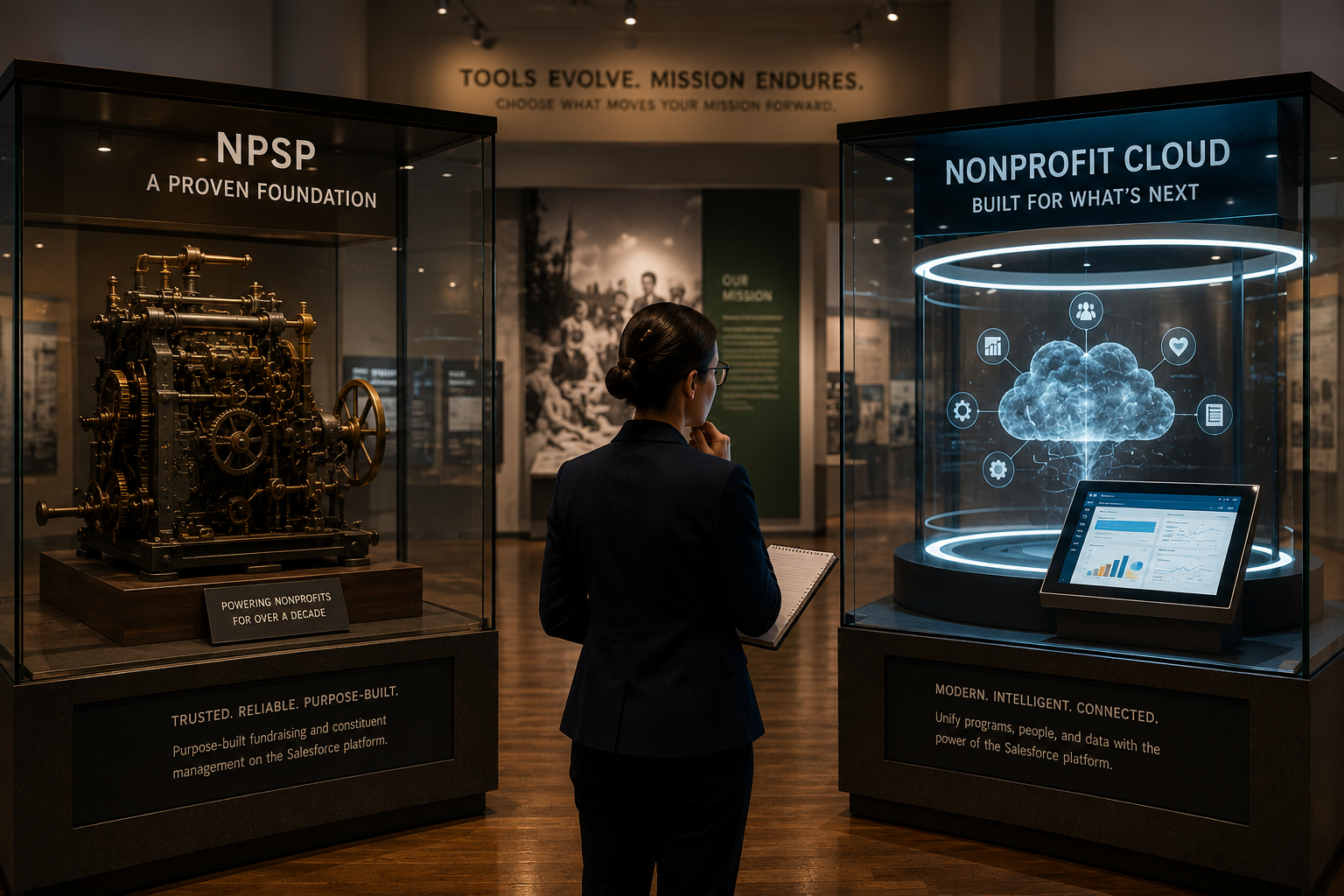
This is the biggest sign of all, and it's rarely about technology. It's about your organization. Think about where your nonprofit was five years ago. Now think about where it is today. Then ask yourself: Has your CRM kept pace? For many nonprofits, the honest answer is no, and not because anyone made a bad technology decision.
Most organizations selected the right CRM for the nonprofit they were at the time. The challenge is that successful nonprofits don't stand still. Their missions evolve, operations mature, and technology needs become more sophisticated. Eventually, the workarounds become the workflow, and the organization realizes it has been working around the CRM instead of working with it.
That's often when organizations begin evaluating Salesforce—not because they need another donor database, but because they need a platform that can support the next chapter of their mission. That might mean Salesforce Nonprofit Cloud, executive reporting through Lightning Dashboards, automation with Salesforce Flow, constituent engagement through Experience Cloud, or productivity improvements using Agentforce.
The goal isn't implementing Salesforce for its own sake. It's removing technology as a barrier to the mission because your mission should determine what's possible, not the limitations of your CRM.
Why Growing Nonprofits Choose Salesforce
If you've made it this far, you may have noticed something: Very little of this article has actually been about software. It's been about growth and what happens when a nonprofit becomes more successful than the systems supporting it. That's a good problem to have, and it's exactly why so many organizations begin evaluating Salesforce for Nonprofits.
Not because Salesforce is right for every organization. Every mission, funding model, and reporting requirement is different. Your CRM should reflect those differences instead of being forced into the same mold.
That's where Salesforce stands apart. Too many CRM projects begin with software demonstrations. The best ones begin by asking a much better question: "What's preventing our people from doing their best work?" Once you answer that, the technology decisions become much clearer.
Your Mission Should Define What's Possible, Not Your CRM
If several of these ten signs sounded familiar, you're not alone. But that doesn't mean your organization made the wrong technology decision. It may simply mean you've been successful enough to outgrow it.
If you're questioning whether your current CRM can support the next stage of growth, start the conversation with your mission, your people, and your processes, not the software. When those conversations happen first, the right technology solution becomes much easier to identify.
And if Salesforce is that solution, implementing it with experienced guidance and a long-term strategy can help your organization strengthen constituent relationships, improve operational efficiency, and create greater impact. Salesforce is simply the platform. The real transformation comes from aligning people, processes, and technology around your mission.
Ready to Find Out if Salesforce Is the Right Fit for Your Nonprofit?
At Dynamic Specialties Group (DSG), we help nonprofits evaluate their technology, identify opportunities for improvement, and design Salesforce solutions that support long-term growth, not just today's requirements.
Whether you're considering your first Salesforce implementation, planning a nonprofit CRM migration, optimizing an existing Salesforce environment, or looking for ongoing Salesforce managed services, our team is here to help.
We'll help you spend less time working around your technology and more time advancing your mission. Let's explore whether Salesforce is the right long-term strategy for your nonprofit—and, if it is, build a solution that grows alongside it.



SHARE