

Every Salesforce release follows a familiar pattern: The release notes arrive, LinkedIn fills with posts announcing everyone's "Top 50 New Features," admins start bookmarking pages they'll probably never revisit, and someone in leadership forwards an article asking whether the organization is "taking advantage of all the new AI." Then Monday morning rolls around, users log in, and everyone discovers the feature that actually mattered was the one nobody spent much time talking about. And that is the challenge with every Salesforce release.
Salesforce Winter '27 Is Almost Here. Here's Where You Should Focus.
Salesforce delivers hundreds of enhancements three times a year, but very few organizations have the time—or the need—to implement all of them. The real value isn't found in enabling every new capability. It's found in identifying the handful of changes that improve productivity, strengthen security, simplify administration, or remove friction from your users' day-to-day work.
The Salesforce Winter '27 Release continues Salesforce's long-term investment in Agentforce, AI, automation, security, and platform modernization. Some updates deserve immediate attention. Others should be tested, evaluated, and introduced when they align with your organization's priorities. Knowing the difference is what separates strategic Salesforce teams from organizations that simply chase every shiny new feature.
So instead of walking through hundreds of pages of release notes, let's focus on the updates that matter most, why they matter, and how to prepare your Salesforce environment before production is upgraded.
Salesforce Winter '27 Release Schedule: Important Dates
Before diving into new functionality, it's worth remembering that the release process doesn't begin when your production org is upgraded. It begins weeks earlier. In fact, Salesforce gives customers approximately six weeks to evaluate new functionality in preview sandboxes before those same changes reach production. Organizations that take advantage of that testing window almost always experience smoother upgrades, fewer surprises, and significantly less stress.
For the Winter '27 Release, these are the dates worth putting on your calendar.
|
Date |
Milestone |
|
August 14 (Expected) |
Salesforce Winter ‘27 Release Notes Go Live |
|
August 27 |
Deadline to refresh sandboxes for the Winter '27 Preview |
|
August 28–29 |
Preview sandboxes upgrade to Winter '27 |
|
October 9–10 |
First production release weekend |
|
October 16–17 |
Second production release weekend |
|
October 23–24 |
Final production release weekend |
Rather than upgrading every customer at once, Salesforce deploys Winter '27 across three staggered production weekends, depending on your instance. If your sandbox isn't on a preview instance before the August refresh deadline, you'll miss the opportunity to validate Winter '27 before your production environment is upgraded.
Those six weeks disappear quickly when you're testing Flows, integrations, reports, Apex code, Experience Cloud sites, security controls, and user acceptance. The earlier you begin, the better prepared you'll be when your production upgrade arrives.

The Sandbox Preview Is More Important Than Release Weekend
One of the biggest misconceptions about Salesforce releases is that the work starts when production changes arrive. In reality, that's when the work should already be finished, and that’s because the sandbox preview exists for a reason: it's your opportunity to discover problems before your users do.
That means validating Flow automations, testing Apex, reviewing integrations, confirming AppExchange packages still behave as expected, checking Lightning pages, and making sure reports, dashboards, and security settings continue working exactly as intended. It's also the ideal time to involve business stakeholders, gather feedback from power users, and identify training opportunities before everyone logs into production wondering why something looks different.
Think of the sandbox preview as your dress rehearsal. If opening night is your production upgrade, you want every surprise to happen during rehearsal, not in front of your audience.
The Biggest Winter '27 Theme: Agentforce Is Becoming Part of Everyday Salesforce
Over the past year, Salesforce has made one thing abundantly clear: Agentforce isn't just another product. It's becoming the centerpiece of Salesforce's platform strategy. Winter '27 continues that evolution by embedding AI-powered assistance more deeply into the everyday Salesforce experience instead of treating AI as a separate destination. And that's an important shift to understand.
Rather than asking users to leave their workflow to interact with AI, Salesforce continues integrating Agentforce, Data Cloud (aka Data 360), and Einstein capabilities directly into the places where people already work. Whether it's surfacing relevant information, assisting with repetitive tasks, improving search, or helping users complete work more efficiently, the goal is the same: make AI feel less like an add-on and more like a natural part of the CRM.
For most organizations, that changes the conversation. Instead of asking, "How do we implement AI?" leaders should be asking, "Where can AI remove unnecessary work without disrupting the way our teams already operate?" That's a much better question, and one that's more likely to deliver measurable business value.
Winter '27 Highlight
Agentforce continues moving closer to everyday work, not separate AI tools.
Winter '27 builds on Salesforce's strategy of embedding AI directly into CRM workflows rather than requiring users to switch between applications. Expect continued investments in AI-assisted productivity, contextual recommendations, and intelligent automation that help users complete everyday tasks faster while keeping people in control of business decisions.
Why it matters: The biggest return on AI often comes from saving employees a few minutes dozens of times each day—not replacing them altogether.
Flow Builder Continues to Be Salesforce's Automation Strategy
If you've been waiting for Salesforce to change course and revive Workflow Rules or Process Builder, Winter '27 isn't that release. Flow Builder is no longer simply Salesforce's preferred automation tool; it's the strategic automation platform for the future.
That direction has been clear for several releases, and Winter '27 continues investing in making Flow easier to build, troubleshoot, and maintain. Salesforce
Some of the enhancements in recent releases—such as improved Flow debugging, Flow version comparisons, and expanded testing capabilities—illustrate where Salesforce continues investing its development resources. Winter '27 builds on that same trajectory rather than introducing an entirely new automation paradigm.
For organizations already using Flow extensively, that's good news because it means another opportunity to refine existing automation, reduce technical debt, and improve long-term maintainability. For organizations that still rely on older automation frameworks, the message remains unchanged: the longer legacy automation remains in place, the more difficult future modernization becomes.
Winter '27 Highlight
Flow Builder keeps getting easier to manage.
Salesforce continues investing heavily in Flow Builder with enhancements aimed at improving debugging, testing, deployment, and overall administrator productivity. Rather than introducing a new automation platform, Winter '27 builds on the steady improvements that have made Flow the long-term automation standard across Salesforce.
Why it matters: Better automation isn't just about building new Flows. It's about making existing automation easier to understand, troubleshoot, and maintain.
Security Is Becoming Less Optional and More Proactive
Security enhancements rarely become the headline feature of a Salesforce release, but they're also usually the changes with the greatest long-term impact. Winter '27 continues Salesforce's broader effort to strengthen authentication, modernize integrations, and improve platform governance. One of the most significant release updates affects organizations still using the legacy OAuth 2.0 username-password flow for connected apps. Salesforce has announced the retirement of this authentication method and recommends migrating affected integrations to more secure alternatives, including the OAuth 2.0 web-server flow with PKCE or the client credentials flow for server-to-server integrations.
Even if your organization isn't affected by that specific change, the underlying message is clear.
Salesforce continues raising the security baseline across the platform through stronger authentication, enhanced MFA requirements, tighter identity controls, email domain verification, and other security-focused release updates.
Every Salesforce release should include more than a feature review; it should include a security review. Ask questions like: Are we still relying on older authentication methods? Do our connected applications follow current best practices? Are permission sets replacing legacy profile-based permissions where appropriate? Have we reviewed Salesforce's recommended release updates before they become mandatory?
Those conversations rarely generate excitement, but they're also some of the most valuable conversations your Salesforce team can have.
Winter '27 Highlight
Now is the time to modernize older integrations.
Salesforce continues encouraging customers to move away from legacy authentication methods, including the OAuth 2.0 username-password flow, in favor of more secure alternatives. If your organization maintains older integrations, Winter '27 is an ideal opportunity to identify them, plan remediation, and avoid last-minute surprises before future enforcement deadlines.
Why it matters: Security improvements are much easier to implement proactively than reactively.
The Real Opportunity Isn't New Features, It's a Better Salesforce Org
One of the easiest traps to fall into after every Salesforce release is assuming success means enabling as many new capabilities as possible. In reality, the healthiest Salesforce environments usually do the opposite. They evaluate each enhancement against one simple question: Does this solve a real business problem? Sometimes the answer is yes, but sometimes it's "not yet." And that's perfectly acceptable.
Every new feature introduces change, and that requires testing, which requires time. And guess what? Time requires resources. The organizations that consistently get the most value from Salesforce aren't the ones racing to turn everything on. Instead, they're the ones making thoughtful decisions based on business priorities, user adoption, governance, and long-term platform health. That's a far more sustainable strategy than chasing every headline feature simply because it's new.
What the Salesforce Winter '27 Release Means for Nonprofits
Every Salesforce release looks a little different when you're a nonprofit. Commercial organizations often measure success by sales pipelines, quarterly revenue, and customer retention. Nonprofits measure success by people served, grants secured, volunteers coordinated, families housed, meals delivered, or lives changed. The technology may be the same, but the mission is fundamentally different.
That's why nonprofit organizations should evaluate the Salesforce Winter '27 Release through the lens of mission impact—not feature count.
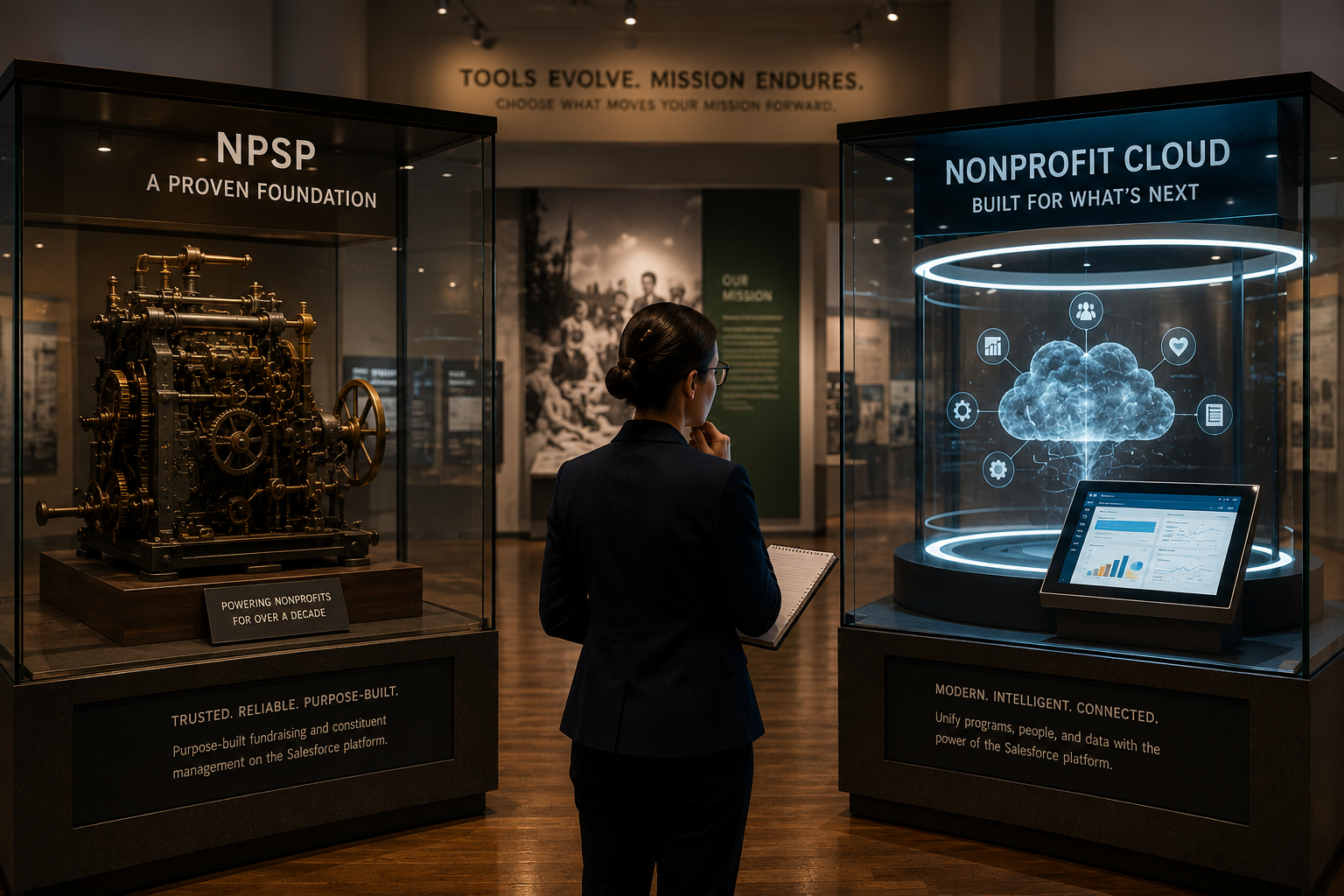
Whether your organization has adopted Salesforce Nonprofit Cloud or continues to rely on the Nonprofit Success Pack (NPSP), every release is an opportunity to improve the way your staff works. While Salesforce continues investing in the future of Nonprofit Cloud (aka Salesforce Nonprofit), many organizations remain on mature NPSP implementations that continue to deliver significant value. The right roadmap depends on your organization's goals, staffing, and long-term strategy, not simply on what's newest.
As you begin testing Winter '27, pay close attention to enhancements that reduce manual work, improve reporting, strengthen automation, or help staff find information more quickly. Small improvements to administrative workflows can have an outsized impact on organizations where employees often wear multiple hats and every hour saved can be redirected toward advancing the mission.
Instead of asking, "What's new in Winter '27?" Ask a better question: "What will help our staff spend more time serving people?" That's where the real value of every Salesforce release begins.
Housing Nonprofits: Focus on the Workflows That Matter Most
Housing nonprofits occupy a unique place within the Salesforce ecosystem. Unlike organizations that primarily use Salesforce for fundraising or donor engagement, housing providers frequently depend on Salesforce to support nearly every aspect of daily operations. A single implementation may include coordinated entry, client intake, case management, housing navigation, landlord engagement, inspections, supportive services, property information, grant reporting, donor management, volunteer coordination, and executive reporting—all while exchanging data with multiple external systems.
That's a lot of moving parts, and precisely why every Salesforce release deserves careful planning. Rather than evaluating Winter '27 one feature at a time, housing organizations should evaluate it one workflow at a time.
Will new automation reduce repetitive work for case managers? Can reporting improvements simplify grant compliance? Will AI help frontline staff locate participant information faster? Can administrative enhancements reduce the amount of time employees spend navigating Salesforce instead of working directly with clients? Those are the questions worth answering during sandbox testing.
Housing nonprofits should also prioritize validating every business-critical integration before production upgrades begin. That includes connections with HMIS platforms, financial systems, document management solutions, GIS and mapping tools, electronic signature platforms, state or local reporting systems, and other applications that support daily operations. Even relatively small platform changes can affect downstream processes if integrations haven't been thoroughly tested.
Sometimes the most valuable Winter '27 enhancement won't be the most exciting one. It will be the one that gives a case manager an extra hour to work with clients instead of completing administrative tasks.
Winter '27 Highlight for Housing Nonprofits
Protect your mission-critical workflows first.
The success of a Salesforce release isn't measured by how many new features you enable. It's measured by whether your staff can continue serving clients without interruption. Before rolling out Winter '27, use the sandbox preview to validate the workflows your organization depends on every day—from coordinated entry and case management to HMIS, grant reporting, property management, financial systems, and document management. Once those mission-critical processes are running smoothly, you can evaluate new capabilities with confidence.
Why it matters: The best Winter '27 implementation protects the workflows your team relies on while reducing the administrative work that takes time away from serving your community.
Three Things Every Salesforce Team Should Do Before Production
Organizations that experience the smoothest Salesforce releases rarely have a secret advantage: they simply prepare. Before Winter '27 reaches production, every Salesforce team should focus on three priorities.
- Test your business-critical automations. If your organization relies heavily on Flow Builder, Apex, integrations, or custom business processes, the sandbox preview is the time to validate every mission-critical workflow. Don't assume yesterday's automation will behave exactly the same tomorrow.
- Review your security posture. Every release presents an opportunity to revisit connected applications, authentication methods, permission sets, release updates, and identity controls. Security improvements may not be the most visible part of a release, but they're often among the most important.
- Involve your users before production day. Administrators understand how Salesforce works. Your employees understand how work actually gets done. Those perspectives are equally valuable. Power users frequently uncover usability issues or process improvements that technical testing alone might never reveal.
The more feedback you gather during the sandbox preview, the fewer surprises you'll encounter after production goes live.
Don't Turn Everything On
Here's a piece of advice that might sound surprising coming from a Salesforce consulting partner: you don't need every new feature. In fact, you probably shouldn't enable every new feature because one of the biggest misconceptions surrounding Salesforce releases is that organizations somehow fall behind if they don't immediately adopt every enhancement. The opposite is usually true.
Healthy Salesforce environments evolve intentionally. New capabilities deserve testing. They deserve governance, stakeholder input, and user training. Some features will deliver immediate value, while others may make more sense after internal processes mature or after future Salesforce releases expand their capabilities. The point is, Salesforce gives you choices, but good governance helps you make the right ones.
Dynamic Specialties Group's Recommendation
Every Salesforce release creates opportunity, but it also creates temptation. The temptation is to focus on what's new. The opportunity is to focus on what matters. We encourage organizations to begin every release cycle by identifying their business priorities, not the newest features in the release notes. Once those priorities are clear, evaluating Winter '27 becomes much simpler.
Does a new capability improve user adoption? Does it eliminate repetitive work? Does it strengthen reporting or governance? Does it improve the experience for employees, customers, donors, constituents, or volunteers? If the answer is yes, it's worth exploring. If the answer is no—or not yet—it's perfectly acceptable to wait.
Salesforce isn't a competition to see who enables the most features. Rather, it's a platform for building better business processes over time.
Final Thoughts
The Salesforce Winter '27 Release isn't about reinventing Salesforce. It's another step in the platform's evolution toward a CRM that's more intelligent, more automated, more secure, and easier to manage. Some of the most valuable enhancements won't make the keynote presentations or dominate social media discussions. Instead, they'll quietly reduce administrative work, improve governance, strengthen security, and help employees make better decisions every single day. And those improvements tend to deliver the greatest long-term return because they become part of everyday work—not one-time projects.
Salesforce delivers three major releases every year, but the organizations that consistently benefit from those releases have one thing in common: they treat every release as an opportunity to improve their CRM strategically, not just technologically.
As you prepare your preview sandbox, review the Winter '27 Release Notes (expected to go live on August 14) and begin testing new functionality; remember this: You don't have to implement everything; you simply have to implement what makes your organization better. That's a much more achievable goal and a far more valuable one.
Talk to a Salesforce Expert
Salesforce releases move quickly, but implementing the right changes doesn't have to be overwhelming. Whether you're evaluating the Salesforce Winter '27 Release, modernizing an existing Salesforce org, planning a migration from NPSP to Nonprofit Cloud, optimizing Flow Builder, strengthening security, or exploring Agentforce and AI, Dynamic Specialties Group can help you identify the enhancements that deliver measurable business value.
Our experienced Salesforce consultants help organizations translate release notes into practical roadmaps, prioritize what matters most, and implement new capabilities with confidence. Because a successful Salesforce release isn't measured by how many features you enable. It's measured by how much better your organization performs afterward.



SHARE